
What Is the Best Outdoor Pathway Lighting in Wilsonville, OR?
Category Walkway Installation
What Is the Best Outdoor Pathway Lighting in Wilsonville, OR?
Outdoor pathway lighting Wilsonville OR homeowners install through Grover’s Landscape Services & Design is almost always low-voltage LED hardwired to a transformer, not solar. In Oregon’s rain shadow, that distinction matters more than almost anywhere in the country. In fact, it’s the first question we answer on every Wilsonville lighting estimate. The best pathway lighting for our climate starts with one idea: understanding why Oregon’s fall and winter make one choice clearly right and the other a recurring disappointment.
By Yuriy Cheshev, Owner · Grover’s Landscape Services & Design · Last updated 9th July 2026
What Is the Best Pathway Lighting for Oregon’s Rainy Climate?
The best pathway light for a rainy climate comes down to two decisions: power source and fixture material. Both are shaped directly by what Wilsonville’s weather does to outdoor lighting from October through April.
Power Source: Low-Voltage Hardwired LED Wins Decisively
A professionally installed 12V low-voltage system runs through a transformer. As a result, it delivers consistent, programmable, timer-controlled illumination every night, regardless of whether the sun appeared that day. In the Willamette Valley, from October through March, it routinely doesn’t.
Solar pathway lights, by contrast, require 6–8 hours of adequate sunlight per day to fully charge. Only then can they deliver 10+ hours of reliable overnight illumination. However, Wilsonville and the broader Clackamas and Washington County area average only 2–3 usable solar hours per day from November through February. Those are the exact months when darkness falls by 4:30 PM and path lighting matters most. The result is predictable. As a result, solar fixtures dim significantly by 10 PM, fail entirely on consecutive overcast days, and are dead by the time you want to use the back path on a January evening.
For the permanent, year-round walkway lighting installation Clackamas County homeowners depend on for safety, low-voltage hardwired LED is the clear choice. Solar has a place in sunny interior Oregon climates. Even so, it does not perform reliably in the wet, west-of-the-Cascades Portland metro.
Fixture Material: Brass and Copper Over Aluminum
Oregon’s mild-acid rainfall accelerates corrosion of uncoated aluminum fixtures from the inside out. For example, a $15 aluminum stake light from a home improvement store typically shows socket corrosion and seal failure within 18–24 months of Pacific Northwest rain exposure.
Brass and copper fixtures, by contrast, develop a natural verdigris patina in Oregon’s wet conditions, which is chemically protective and stable. Installed properly in Wilsonville, professional-grade brass path lights last 15–25 years. Moreover, they hold their appearance better against the wet Oregon backdrop. There, muted greens and weathered metals complement Pacific Northwest landscape aesthetics far better than corroded aluminum.
Weather Rating: IP65 Minimum
Oregon’s persistent horizontal misting rain is not the same as a summer downpour. Specifically, it penetrates fixtures designed for intermittent rain but not continuous moisture exposure. Therefore, any path light for a Wilsonville installation should carry an IP65 minimum rating. IP67 is a good step up for fixtures in low-lying areas that pool.
For that reason, as top-rated walkway lighting contractors in the Portland metro and the best pathway lighting installers near Wilsonville OR, Grover’s Landscape specifies brass or corrosion-resistant fixtures with IP65+ ratings on every Clackamas County project.

How Much Does Pathway Lighting Cost?
In practice, pathway lighting cost in Wilsonville and the Portland metro depends on three things: fixture count, wire run length, and whether a transformer is already in place.
Per-fixture cost (professional installation):
- Entry-level brass or die-cast zinc path lights: $100–$150 per fixture installed
- Mid-range brass or high-quality composite: $150–$225 per fixture installed
- Premium solid brass or copper with adjustable beam heads: $225–$350 per fixture installed
Typical project totals:
- Front walkway, 40–60 linear feet, 6–10 fixtures: $800–$1,800 installed
- Full front and backyard pathway system, 12–20 fixtures: $1,800–$4,200 installed
- Large estate path system, 20–30+ fixtures: $4,000–$8,000+
- New transformer (150W smart with timer/photocell): $200–$350 installed
Adding to an existing system: Many Wilsonville homes already have builder-installed landscape transformers with significant unused capacity, particularly in Villebois and Charbonneau District properties built in the 2000s–2010s. LED path lights draw only 5–7 watts each. For instance, a 150W transformer with 60W already committed can typically absorb 12–18 additional path lights before an upgrade is needed. As a result, adding path light installation Portland OR properties already wired for landscape lighting costs significantly less per fixture, because the transformer and primary wire run already exist.
In every case, Grover’s Landscape provides a fixed written quote after a site visit.
How Far Apart Should Pathway Lights Be?
Spacing is the installation question we field most often on Wilsonville landscape lighting projects. The answer is fixture-dependent, not a fixed number.
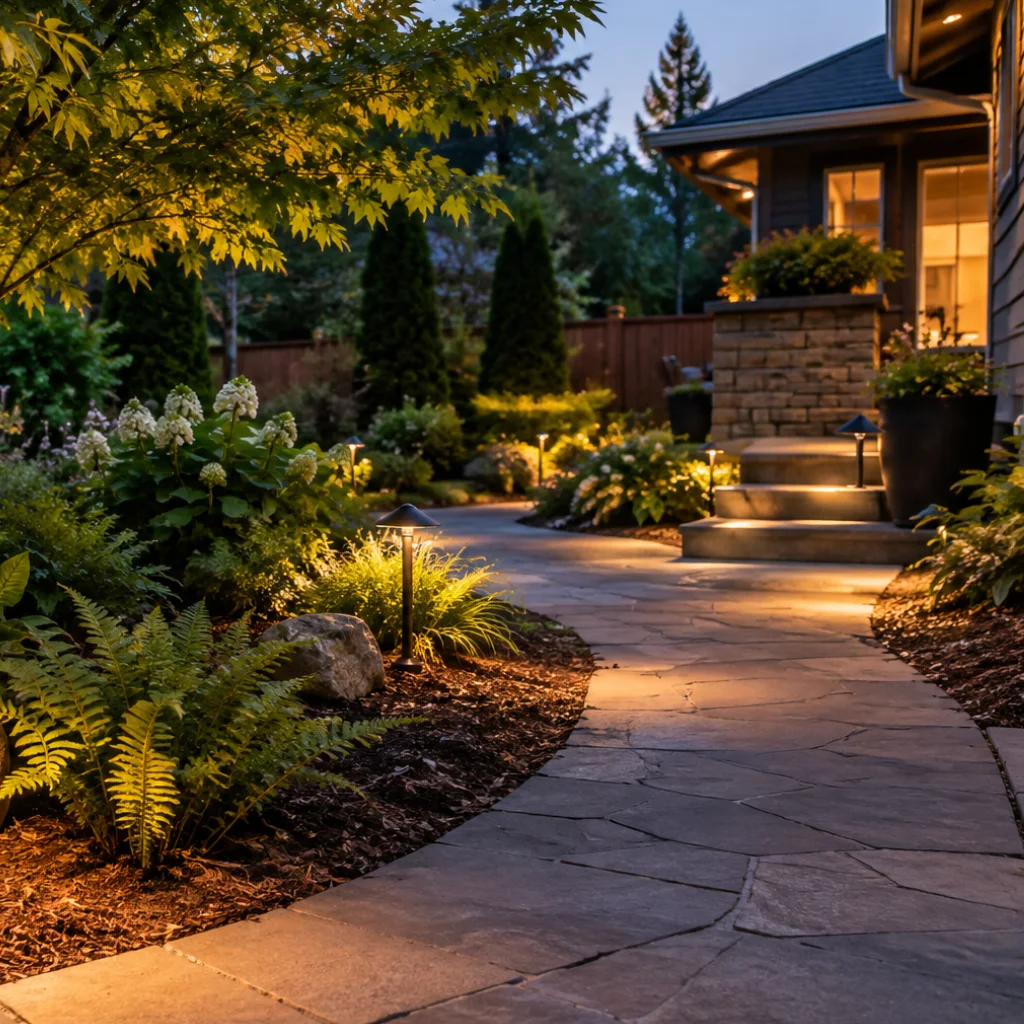
Standard spacing guideline: 6–10 feet apart on alternating sides of the path for most residential walkways. The staggered placement, set on opposite sides rather than matching pairs, creates a more natural rhythm. In addition, it provides better surface coverage than paired placement.
Adjusting for specific conditions:
- Curves and grade changes: Tighten to 4–6 feet. Shadows pool at curves when fixtures are spaced for straight runs, and the footing uncertainty at a grade change calls for extra illumination.
- Straight flat runs: 8–10 feet suits 100+ lumen LED fixtures. Wider spacing at that output still provides overlapping pools of light without the “runway” effect of over-lit paths.
- Steps and entry approaches: One fixture at each step or landing change, regardless of the regular run spacing. Steps are the single highest-fall-risk zone in any landscape.
- Driveway lighting Pacific Northwest properties with long runs: Bollard fixtures (18–36 inches tall, 360-degree illumination) can extend spacing to 10–15 feet on straight driveway runs, which reduces fixture count without compromising coverage.
Lumen output affects spacing: A 30–50 lumen fixture needs closer spacing (6 feet) to achieve continuous coverage without dark gaps. By contrast, a 100–150 lumen fixture can extend to 8–10 feet and still overlap adequately. Going beyond 150 lumens per fixture on a residential walkway creates glare, so the fixture outshines the path surface rather than illuminating it.
Grover’s approach: We walk every run at dusk during design, using temporary test fixtures before committing to final placement. Wilsonville’s landscape varies a lot — from Villebois’ paver-edged walks to Charbonneau’s connecting cart paths and Montebello’s new construction. Therefore, the right spacing is always site-specific.
How Bright Should Pathway Lights Be?
For most Wilsonville residential walkways, 30–50 lumens per fixture is the practical target. That’s enough to define the path edge and provide safe footing, but not so bright that fixtures dominate the landscape.
What too-dim looks like: Below 15–20 lumens per fixture, the path is marked but not illuminated. That’s insufficient for safety on uneven paving or wet stone pavers, which describes most Wilsonville paths from October through May.
What too-bright looks like: Above 150 lumens per fixture on a residential walkway, the fixture becomes the focal point rather than the path. Glare then reduces effective vision and creates harsh contrast between lit and unlit areas.
Color temperature: 2700K–3000K (warm white) is the right range for Wilsonville residential path lighting. For example, warm white complements Pacific Northwest landscapes such as cedar, basalt, native ferns, and Oregon grape. In addition, it produces far less visual harshness against dark, wet Oregon evenings than cooler 5000K+ daylight temperatures.
Practical note: Budget path light lumen ratings are frequently overstated and measured at initial brightness. Grover’s Landscape specifies fixtures with field-verified output consistent with design targets, not the packaging claim.
Do Pathway Lights Need to Be Solar?
No. In Wilsonville, solar is the wrong choice for primary pathway lighting from October through April, which is when pathway lighting matters most.
As covered above, solar pathway lights require adequate sun exposure to charge. However, Oregon’s October–March period routinely provides only 2–3 usable solar hours per day. So the math doesn’t produce reliable overnight illumination during the dark half of the year. That’s precisely when Wilsonville residents need path lights working at 5 PM on a wet November evening.
Where solar can work in Wilsonville: Solar fixtures can supplement a low-voltage hardwired system in full-sun spots. Think a south-facing front walkway with no canopy that gets 6+ hours of unobstructed sun even in summer. In that limited scenario, and as accent markers from May through September, solar works.
For year-round Wilsonville use, low-voltage hardwired path light installation Portland OR and Clackamas County is the correct system. It’s timer-controlled, photocell-enabled, and completely independent of daily weather.

How Deep Are Pathway Lights Installed?
Low-voltage landscape wire must be buried at a minimum of 6 inches, per NEC Article 411 requirements for LVLD (Low Voltage Lighting and Power Distribution) systems. Grover’s Landscape installs at 8–10 inches as standard practice in Wilsonville, for two Oregon-specific reasons.
Frost heave in Wilsonville’s clay soil: The Willamette Valley’s heavy clay soils expand as they absorb moisture and, in turn, contract as they dry. During Wilsonville’s 10–15 annual nights below freezing, shallow wire runs at 4–6 inches are vulnerable to frost heave. Over repeated freeze-thaw cycles, the wire migrates upward until it’s exposed at the surface or pulled taut against fixture bases. At 8–10 inches, by contrast, the wire sits below the active frost zone.
Lawn aerators and edgers: Standard aerator plugs reach 3–4 inches, and edger blades run 4–5 inches. Wire at 6 inches therefore sits at the margin of edger damage. At 8–10 inches, it’s safely below both tools.
Where conduit is required: Under paved surfaces — driveways, paver patios, concrete walkways — wire must run through PVC conduit regardless of depth. For that reason, Grover’s sleeves wire under any hardscaped surface at installation, so future wire access doesn’t require cutting paving.
Fixture stake depth: Path light stake depth varies by fixture design, typically 6–10 inches. However, the stake sets the fixture at its intended operating height (12–18 inches above grade) rather than anchoring the wire. The wire itself is the element that needs proper depth.
Frequently Asked Questions
How far apart should pathway lights be?
6–10 feet on alternating sides for most Wilsonville walkways. Tighten to 4–6 feet at curves, grade changes, and steps. 8–10-foot spacing works on straight flat runs with 100+ lumen fixtures. Always light every step and grade change, regardless of the regular run spacing.
Do pathway lights need to be solar?
No. In Wilsonville, solar is not appropriate as primary pathway lighting from October through April. Oregon’s rainy season provides only 2–3 usable solar hours per day, versus the 6–8 required for reliable overnight performance. Low-voltage hardwired LED is the correct year-round Pacific Northwest choice.
How deep are pathway lights installed?
Low-voltage wire is buried 8–10 inches as standard practice in Wilsonville, deeper than the NEC 6-inch minimum. That depth protects against frost heave in Clackamas County clay soil and stays below aerator and edger damage. Under any paved surface, wire runs through PVC conduit.
Can pathway lights be added to existing landscape lighting?
Yes, if the transformer has available capacity. LED path lights draw 5–7 watts each. For example, a 150W transformer with 60W already committed can typically absorb 12–18 additional path lights. Grover’s Landscape assesses transformer capacity as part of every walkway lighting installation Clackamas County estimate.
How do you space pathway lights along a walkway?
Start at safety-critical points: steps, grade changes, the entry approach, and curves. Then fill straight runs at 8-foot intervals on alternating sides for 100-lumen fixtures, or 6 feet for dimmer fixtures. For driveway lighting Pacific Northwest properties with long straight runs, 10–15-foot bollard spacing is appropriate. Finally, test placement temporarily at dusk before committing to final installation.
Contact Grover’s Landscape Services & Design
Grover’s Landscape Services & Design Lake Oswego, OR Phone: (503) 936-8910 Hours: Mon–Fri 8:00 AM–5:00 PM Oregon CCB #100592 · Licensed & Insured · 4.8 Stars on Google
Serving Wilsonville, Tualatin, Sherwood, West Linn, Lake Oswego, and Clackamas County.