
Who Installs Landscape Lighting Near Me in Portland?
Category Landscape Lighting
Who Installs Landscape Lighting Near Me in Portland?
Landscape lighting in Portland is installed by a licensed landscape contractor or an Oregon electrician, and for gardens the safest and most common choice is a low-voltage LED system. Grover’s Landscape Services & Design designs and installs those systems across the Portland metro, with a free site visit and a written proposal before any work starts.
By Yuriy Cheshev, Owner · Last updated October 14, 2026
Which Company Near Me Designs and Installs Low Voltage Lighting?
A landscape contracting business licensed by Oregon’s Landscape Contractors Board, because that license is what lets a company legally install low-voltage lighting for pay. Which company near me designs and installs low voltage lighting? The state’s own Landscape Contractors Board guide lists installing low voltage lighting among the work that requires a license.
Two licenses are involved. The first is an individual landscape construction professional license, earned by passing exams. The second belongs to the business, which carries the bond, the insurance and the contract with you. So a company without both shouldn’t be wiring your yard.
There’s a useful detail for homeowners, too. Also, employees of a licensed business can install the low-voltage wiring for the fixtures, as long as the system is Class 2 or Class 3 and stays under 30 volts and 750 volt-amperes. Each installer must carry an identification card with their name, the business name and the license number. So don’t be shy about asking to see it.
“Design and install” matters as well. At Grover’s, the same crew that draws the plan also installs it, so the person who chose the beam angle is the person aiming the fixture. You can read more on our landscape lighting page.
Why Is Low Voltage Lighting Better Than Line Voltage?
For most gardens, it’s the better fit, because low-voltage systems are safer to work around, easier to change and legal for a licensed landscape contractor to install. Is low voltage lighting better than line voltage? For paths, patios, trees and walls, yes. For a few jobs, though, line voltage still has a place.
Here’s how the two compare:
Low voltage (up to 30 volts) | Line voltage (120 volts) | |
Who may install it in Oregon | A licensed landscape contracting business, within the 30-volt, 750 volt-ampere limit | A licensed electrician, with an electrical permit |
Shock risk | Lower, since a transformer steps power down | Higher, so it needs strict protection |
Changing the layout | Easy to add, move or re-aim fixtures | Changes mean electrician work again |
Best for | Paths, steps, decks, patios, tree and wall lighting | Big floodlights, very long runs, high-power loads |
Also, the legal line matters. Oregon’s electrical license exemption for landscape businesses stops at Class 2 and Class 3 systems up to 30 volts and 750 volt-amperes. Above that the wiring is electrical work with its own license. So if anyone offer to hang 120-volt fixtures in your garden without an electrician, ask more questions.
Meanwhile, permits are a second point. The same state guides says low-voltage lighting may need a permit in many local area, so a good installer checks before digging, not after.
How Long Do LED Landscape Lights Last?
Quality LED modules are rated for tens of thousands of hours, which means well over a decade at a few hours a night. In practice, however, the fixture body, the connections and the wire usually give out before the LED does. The U.S. Department of Energy says LEDs last up to 25 times longer than incandescent bulbs and use up to 90 percent less energy, according to its consumer guide to efficient lighting.
Here’s the math, though. A 25,000-hour rating at four hours a night works out to about 17 years. That’s an example, not a promise, because ratings vary by product and Portland’s wet winters are hard on everything outdoors.
So what fails first? Cheap fixtures corrode and fog. Twist-cap connections let water in. Then buried wire gets nicked by a shovel, and an undersized transformer overheats. Most of the dead systems we replace didn’t fail because of the LEDs. Instead they failed because of everything around them, and that’s why fixture quality matters more than the bulb count on a spec sheet.
What Does Landscape Lighting Installation in Portland Involve?
It involves a site walk, a written design, the install and an after-dark tune-up. For landscape lighting installation Portland homeowners can trust, so those four steps shouldn’t be skipped.
Here’s how our projects run:
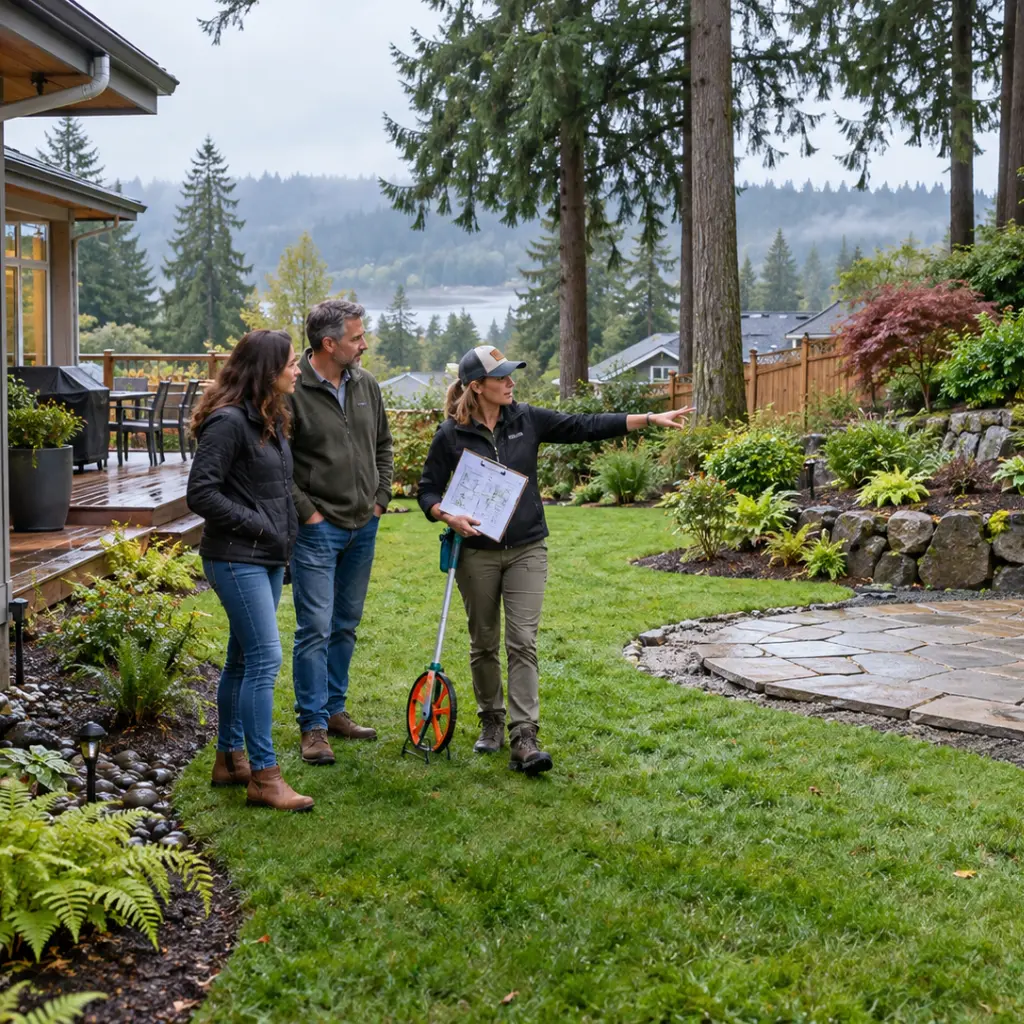
- The site walk. First, we look at the property, sometimes during the day and sometimes at dusk, and ask what you want the lighting to do.
- The written proposal. It lists fixture count, wattage, zone layout, materials and price, so there are no verbal numbers.
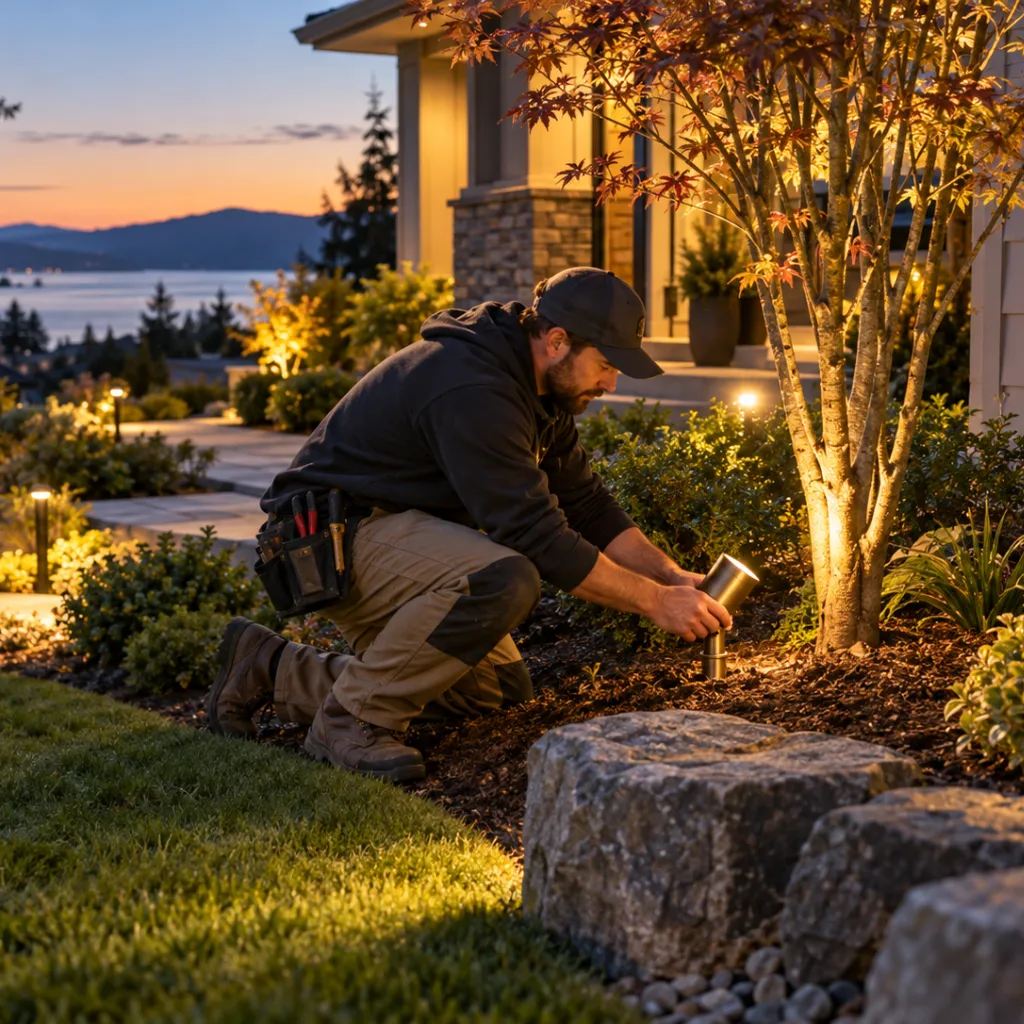
- The install. The crew sets the transformer, runs the low-voltage wire, places the fixtures and tests every run.
- The tune-up. Finally, on larger projects, we return after sunset and adjust the aim and beam angles until it looks the way it was designed.
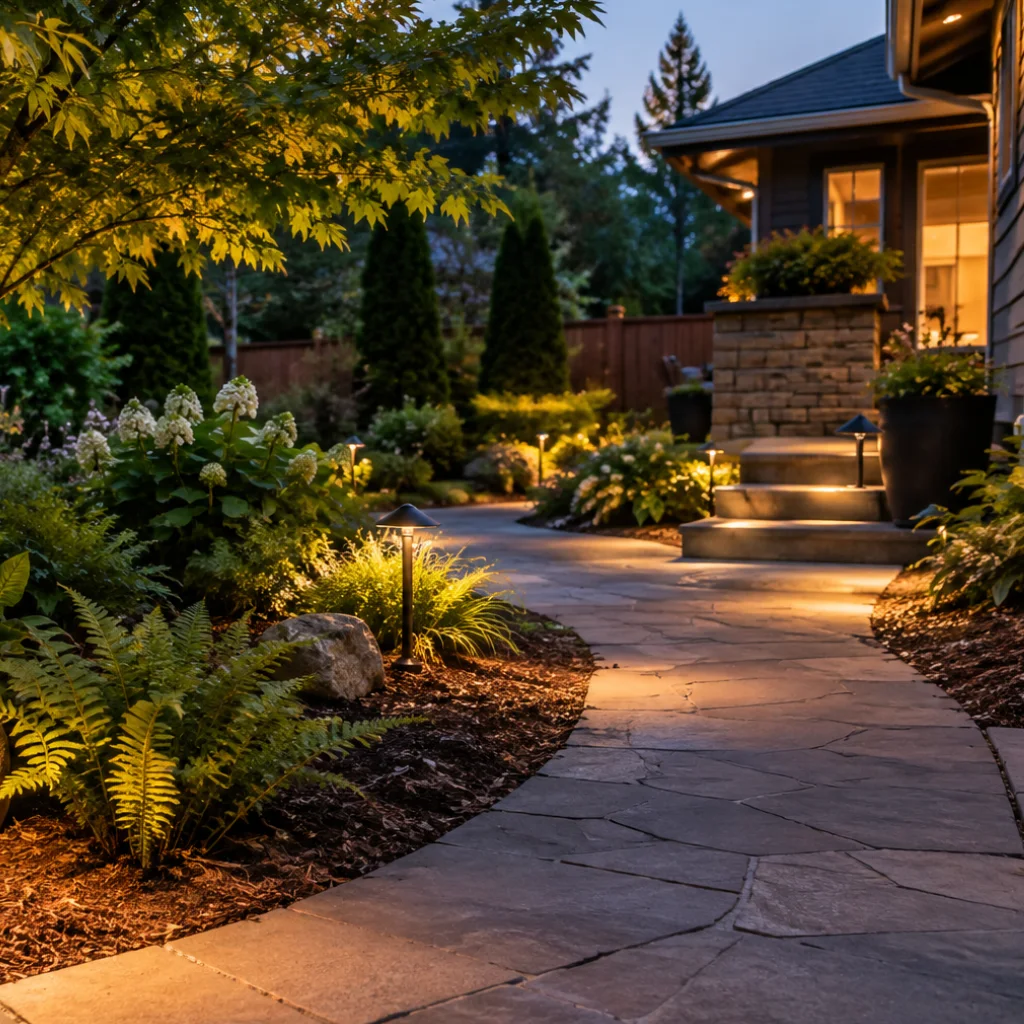
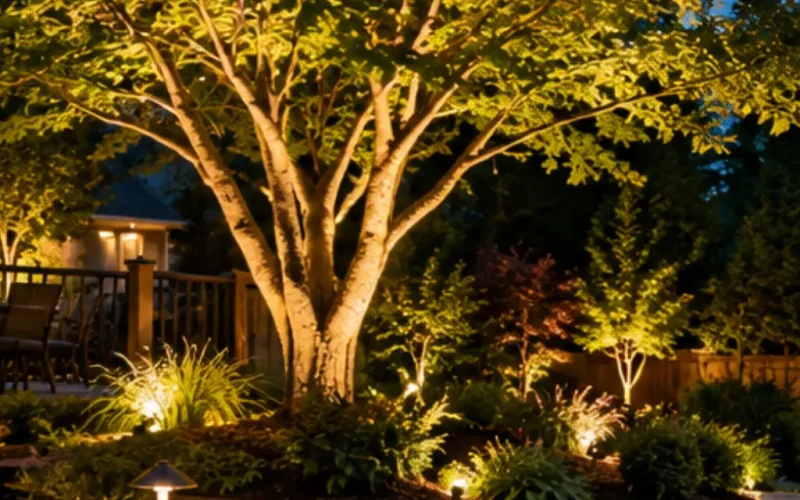
Searching for low voltage LED garden lighting Portland? The best systems light layers instead of everything. Planning path deck and uplighting Portland yards need most? Start where people walk, then where they sit, then what’s worth showing off. In practice, that means path lights for safety, step and post lights for decks and patios, and uplights on a feature tree or a stone wall.
Who Installs Garden Lighting in Portland?
Licensed landscape contractors and licensed electricians do. Who installs garden lighting in Portland, specifically? We do, with our own crew, across Portland, Lake Oswego, Beaverton, Tigard, Tualatin, Sherwood, Wilsonville, West Linn and Oregon City. Beyond that, we also reach Gresham, Milwaukie, Happy Valley, Clackamas and Hillsboro.
Our work covers six things:
- Lighting design for residential and commercial properties
- Pathway lighting for walks, stairs, driveways and garden paths
- Accent and architectural lighting for trees, walls and stone
- Patio, deck and outdoor living lighting
- Holiday lighting, including takedown and storage
- Repair and upgrades for existing low-voltage systems
Every one of them can be a standalone job or part of a larger landscape build. Our Portland location page has coverage details, and our landscaping design guide shows how lighting fits into a full plan.
Who Is the Best Landscape Lighting Installer Near Portland?
The best one for you is the installer who looks at your property before quoting, puts everything in writing and can show a license. Compare any best landscape lighting installer near Portland against this list:
- A license number you can look up, and an ID card on every installer
- A written proposal with fixture count, wattage, transformer size and zones
- Fixtures you can name, such as solid brass or marine-grade metal, not generic plastic stakes
- A plan for the after-dark visit, since daytime aiming rarely survives the first night
- A clear answer on permits, because low-voltage work may need one locally
We’d rather you ask all of this than hire on a price alone. Cheap fixtures rust, fog and crack within a couple of seasons, and then you pay twice. When you’re ready, request a free quote or call (503) 936-8910.
Frequently Asked Questions
How much does landscape lighting cost to install?
It depends on three factors: the number of fixtures desired, the grade selected, and the complexity of the wiring required. First, small jobs for simple path lighting usually cost a few thousand dollars, but full scale design including uplighting, downlighting and hardscape lighting will cost more. We always do a free site visit and provide you with a written proposal so you’ll see exactly what you’re paying for. To get a ballpark figure first, just give us a call and let us know the details of the property.
Why use low-voltage LED rather than line-voltage systems?
Low voltage is safer to work around and easy to change, while LED reduces the power draw. The Department of Energy reports that LEDs use up to 90 percent less energy than incandescent bulbs. But low-voltage requires bigger wires for long runs to avoid voltage drop on the wire, and the transformer size will be determined by how much power you need and the circuit length. We have to size the wire and the transformer.
Can lighting be added to an existing garden or patio?
Yes. For example, we can tuck lights into walls and seat caps, add step lights, and place path lights without tearing up your beds. Wire gets buried or tucked under mulch, with weatherproof connections at every splice. If you already have an older system, we can often keep the wiring and upgrade the fixtures and the transformer, so you don’t redo everything.
Do you install lighting that holds up through wet winters?
Yes, because we build for them. That means corrosion-resistant fixtures, sealed LED modules and weatherproof connectors instead of twist-caps. It also means a properly sized transformer in a code-compliant spot. Most failures we see in older systems trace back to cheap fixtures and flooded connections, so we avoid both.
Do you offer maintenance and seasonal adjustment of the system?
Yes, we service and re-aim systems, including many that other installers built. About a quarter of our lighting calls are repairs. Plants grow, fixtures shift and bulbs age, so a visit every so often keeps the light where you want it. Call (503) 936-8910 and we’ll schedule a look.
Contact or Call Us
Grover’s Landscape Services & Design Serving Portland and surrounding Oregon metro communities
Phone: (503) 936-8910
Hours: Monday to Friday, 8:00 AM to 5:00 PM
Family-owned since 1995. Oregon CCB #100592. Free site visit and written proposal.