

What Do Site Excavation Services Cover In Portland?
Category Site Excavation Services
What Do Site Excavation Services Cover In Portland?
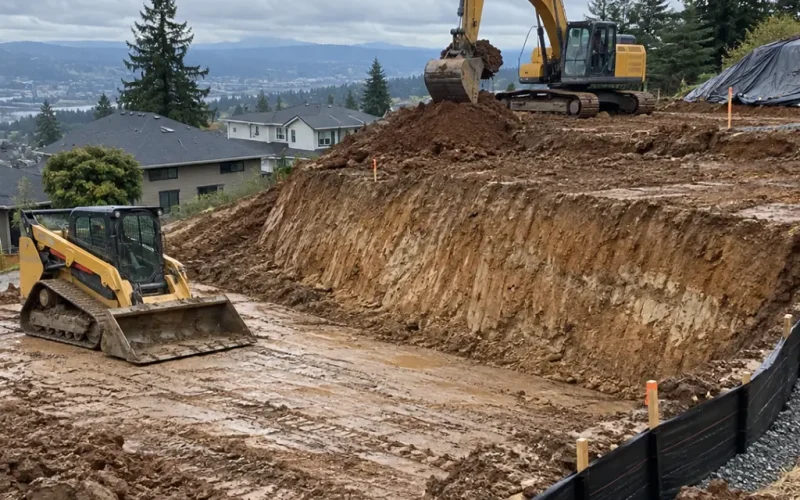
Site Excavation Services in Portland include foundation digging, utility trenches and cut and fill grading, and the associated backfill, compaction and hauling. Work typically starts with utility locates and permits. Then crews dig to the engineer’s plans, protect the soil they’ll build on and leave the site ready for the next trade.
By Yuriy Cheshev, Owner · Last updated October 19, 2026
Why does Portland’s soil change how an excavation contractor works?
It is the heavy clay and long wet season that dictate how, when and how deep excavation contractors in Portland can dig. So anyone searching for an excavation contractor that Portland builders trust should ask about how it handles soil and water.
Here’s what makes local sites tricky:
- Sticky clay that holds water, smears under tracks and loses strength when soaked
- Perched groundwater that can fill a trench after a few days of rain
- Sloped lots in the West Hills and around Lake Oswego, where cuts need extra care
- Tight urban lots with neighbors, trees and utilities close by
- A long rainy season that can stretch from fall through spring
As a result, timing matters. Getting footings in right before a week of storms can turn good subgrade into muck. As a result, good crews stage work, cover exposed soil and keep water moving away from open cuts.
How does foundation and utility trench excavation in Portland work?
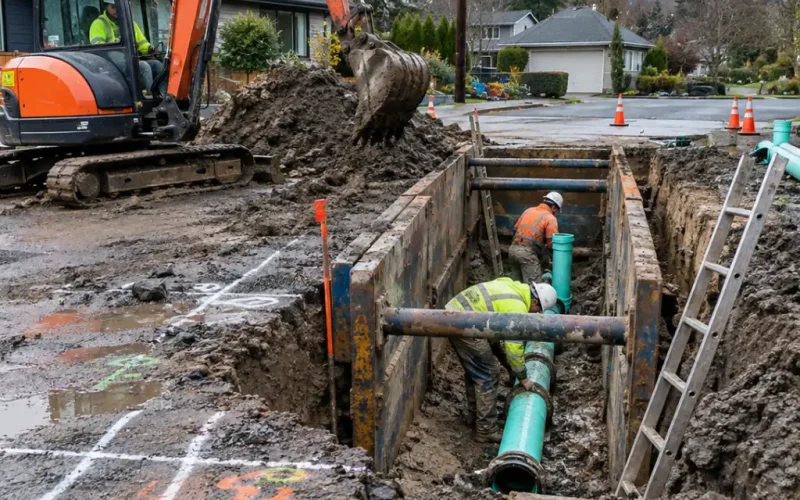
It follows a certain order: locate utilities, lay out the cuts, dig to plan, and then backfill and compact in layers. Builders searching for foundation and utility trench excavation Portland crews can schedule around want each step is done right the first time.
The first step is the law, not the shovel. Many times, people get asked do you need to call 811 before excavating in Oregon. Yes, because the state’s one-call center says excavators must contact them at least two full business days before digging, and no more than 10 business days ahead. The dig area should also be marked in white.
After locates, the work usually looks like this:
Excavation type | What sets the depth | What matters most |
Foundation footings | Engineer’s plans and soil bearing | Undisturbed, firm subgrade at the bottom |
Basement or crawlspace | Plans plus drainage needs | Stable side slopes and water control |
Water and sewer trenches | Utility specs and slope requirements | Correct grade and bedding under the pipe |
Electrical and gas trenches | Utility provider rules | Separation from other lines |
Drainage lines | Fall needed to move water | Steady slope to an approved outlet |
Trench safety matters too. Under workplace safety rules, trenches 5 feet deep or more generally need a protective system such as shoring, sloping or a trench box. Then, once pipes are inspected, backfill goes back in thin, compacted layers, so the ground doesn’t settle later.
What is cut and fill earthwork in Portland?
Cut and fill refers to moving earth to achieve a desired grade on a construction site with minimum haul distance. For anyone searching for cut and fill earthwork Portland projects need, that’s the core idea.
People also ask about the cut and fill balance, which is when the volume of material excavated is comparable with the volume needed for filling or the opposite. The balance minimizes the transportation costs because the number of trucks needed for moving the material is reduced
Several factors affect this balance:
- Soil swells when dug, so loose dirt takes up more space than it did in the ground.
- Soil shrinks when compacted, so fill areas need more material than the hole they came from.
- Wet clay may not be reusable as structural fill without drying or treatment.
- Topsoil gets stripped first and saved for landscaping, not used under buildings.
That’s why the grading plan and the soil type matter so much. A site that looks balanced on paper may still need imported fill once the clay is tested.
When do Portland excavation projects need a permit?
Most excavation in Portland needs a site development permit once earthwork goes past 10 cubic yards. That’s a small amount, roughly a couple of dump-truck loads.
The city lists earthwork, excavation or filling greater than 10 cubic yards as work that needs a site development permit. In addition, erosion control inspectors check these permits. So silt fencing, covered stockpiles and gravel construction entrances are part of the job, not extras.
Other cities in the metro have their own rules. Because of that, we check the local requirements before any digging starts.
What drives site excavation costs in Portland?
Excavation costs depend mostly on volume, soil, access and how much material has to leave the site. So, how much does site excavation cost? There’s no honest flat number without seeing the lot. Here’s what moves the price most:
Cost driver | Why it matters |
Volume of soil moved | More cubic yards means more machine time |
Soil type | Wet clay and rock slow digging and limit reuse |
Site access | Tight lots need smaller machines and more trips |
Hauling and disposal | Trucking and dump fees add up quickly |
Imported fill or rock | Buying base rock or fill adds material costs |
Permits and erosion control | Required measures add setup time |
Season | Wet-season work often needs more water control |
The best way to control cost is a good plan up front. A balanced grading design and dry-season scheduling often save more than any price difference between bids.
Why do builders hire Grover’s site excavation services?
Our site excavation services pair compact equipment with 30 years of experience on Portland-area soil. We’re a family-owned company that’s worked across the metro since 1995.
People often ask who does site excavation for builders in Portland. Others want to know which excavation contractor near me handles utility trenching. And many simply ask who handles cut and fill earthwork in Portland. We do all three, mostly on residential and light commercial sites.
Here’s what you get with us:
- Oregon CCB #100592, with general liability and workers’ compensation coverage
- Mini excavators and compact track loaders sized for tight residential access
- One accountable team from clearing and grading to drainage and landscaping
You can see the full scope on our site preparation and excavation page. If you’re earlier in the project, read our guide to site preparation services in Portland. Working south of the city? Our Tualatin excavation guide covers that area. You can also learn more on our Portland service area page.
How do you get a free excavation estimate?
Call us or request a free quote online, and we’ll walk the site before giving you a written proposal. There’s no obligation after you receive it.
Frequently Asked Questions
What types of excavation do you take on?
We handle foundation and footing excavation, utility and drainage trenches, cut and fill grading, and general site excavation. We also dig for retaining wall footings, ponds and water features. Most of our work is on residential and light commercial sites across the Portland metro.
How is excavated material handled, reused or hauled away?
Good soil is kept on site and reused as fill wherever the plans allow, which cuts trucking costs. Topsoil is stripped and saved for landscaping. Wet clay, debris and anything that can’t be reused gets hauled to an approved disposal site.
Can you work on constrained urban sites with limited access?
Yes, tight urban lots are a big part of our work. We use mini excavators and compact track loaders that fit through narrow side yards and gates. We also plan around neighbors, trees and existing hardscape so they’re protected during the dig.
What equipment and crew capacity do you have available?
Our fleet specializes in mini excavators and compact track loaders for residential and light commercial access. Our crew size and availability fluctuate according to the project and time of year. Just give us a call and let us know the scope and time frame of your project, and we’ll tell you when we’re available.
Are you insured to the limits our project requires?
We carry general liability and workers’ compensation on all our crews for projects under Oregon CCB #100592. We are happy to present proof of insurance upon request, so that you can verify that the limits conform to your contract requirements. If you project requires higher limits or additional insureds, please advise when scheduling so we can confirm our capabilities.
How far ahead should we book excavation?
Allow a couple months, depending on permits and our availability. Utility locates alone take two full business days, and permits can be a drawn out process. We also recommend booking early in the season, to ensure availability during the dry summer months.
Can excavation be done during Portland's wet season?
Yes, during the wet season excavation can be challenging and require extra planning and erosion control. Work will be unavoidably suspended during severe weather, but we’ll do our part to cover bare soil and plan around wet ground conditions as much as possible.
Do you also handle grading and drainage after excavation?
Yes, we offer complete finish grading, drainage installation and cleanup after excavation. This keeps responsibility for one contractor for the entire project, from initial excavation to final grade. It also expedites the jobsite cleanup and coordination with other contractors.
Visit or Call Us
Grover’s Landscape Services & Design
Phone: (503) 936-8910
Email: groverslandscapevwl.design@gmail.com
Hours: Monday to Friday, 8:00 a.m. to 5:00 p.m.
Oregon CCB #100592 · Family-owned since 1995 · General liability and workers’ compensation insured
Serving Portland, Lake Oswego, Beaverton, Tualatin, Sherwood, Wilsonville, Hillsboro, Clackamas, Newberg, West Linn and Salem.