
When Does Outdoor Landscape Lighting Shine In Portland?
Category Outdoor Landscape Lighting
When Does Outdoor Landscape Lighting Shine In Portland?
Outdoor landscape lighting does most of its work in Portland from October through March, when it’s dark before dinner and the garden is wet and half bare. So the best designs are built for the winter yard, not just a summer evening. At Grover’s Landscape Services & Design, we plan lighting around how your plants look in both seasons.
By Yuriy Cheshev, Owner · Last updated October 26, 2026
Why is outdoor landscape lighting a winter project in Portland?
Because that’s when you actually see it. In June, the sun sets so late that lights barely matter. By December, though, it’s dark before 5 p.m., and most of your time at home happens after sunset.
That shift changes what good outdoor landscape lighting should do. Instead of lighting a lush summer canopy, the system spends months lighting bare branches, wet stone and evergreen structure.
The Portland garden also looks different in winter. Japanese maples and dogwoods will shed their leaves and make an architectural feature from the branches. The evergreen trees (Douglas fir, Cedar and Rhododendron) will provide a nice structure. With rain water on the bark and paving stones the lighting will reflect nicely.
When considering the various types of exterior lighting available, it can be helpful to categorise them by their purpose:
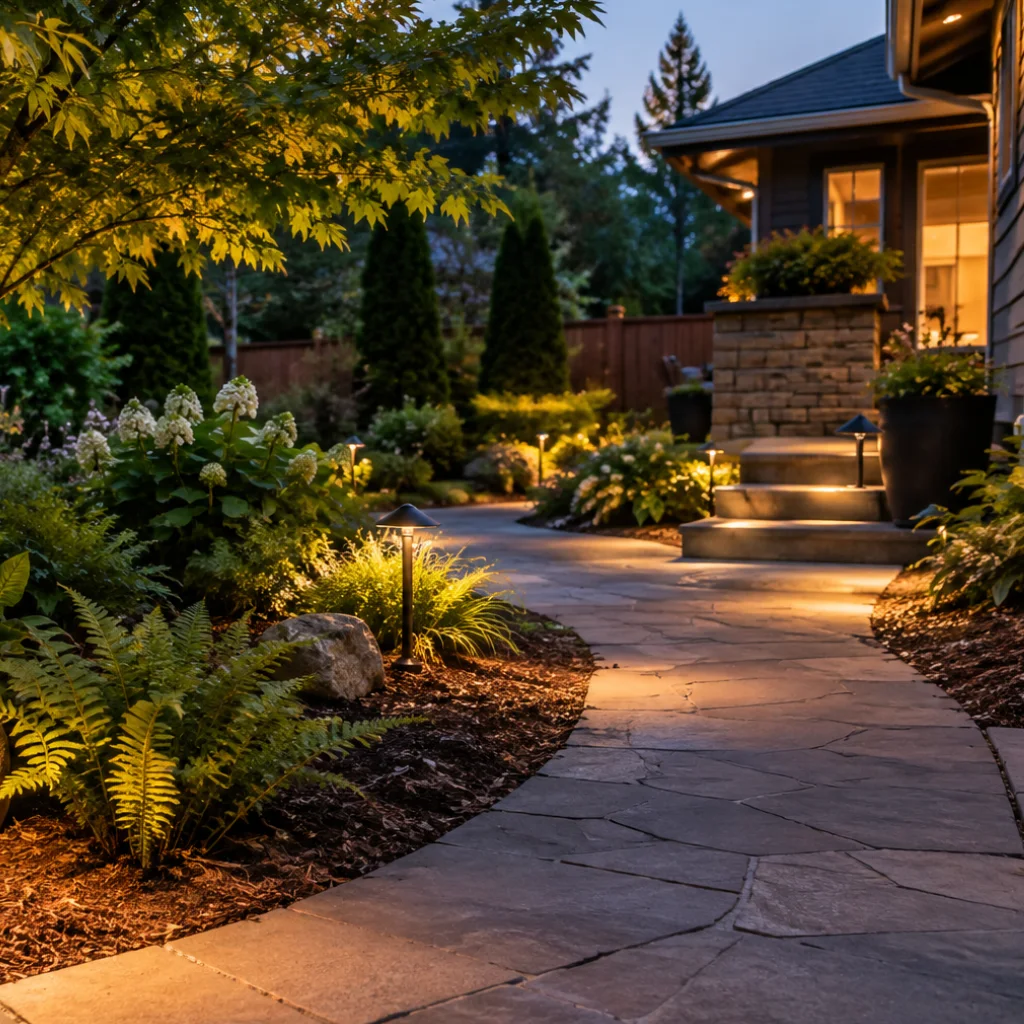
- Path lights for walkways, steps and edges
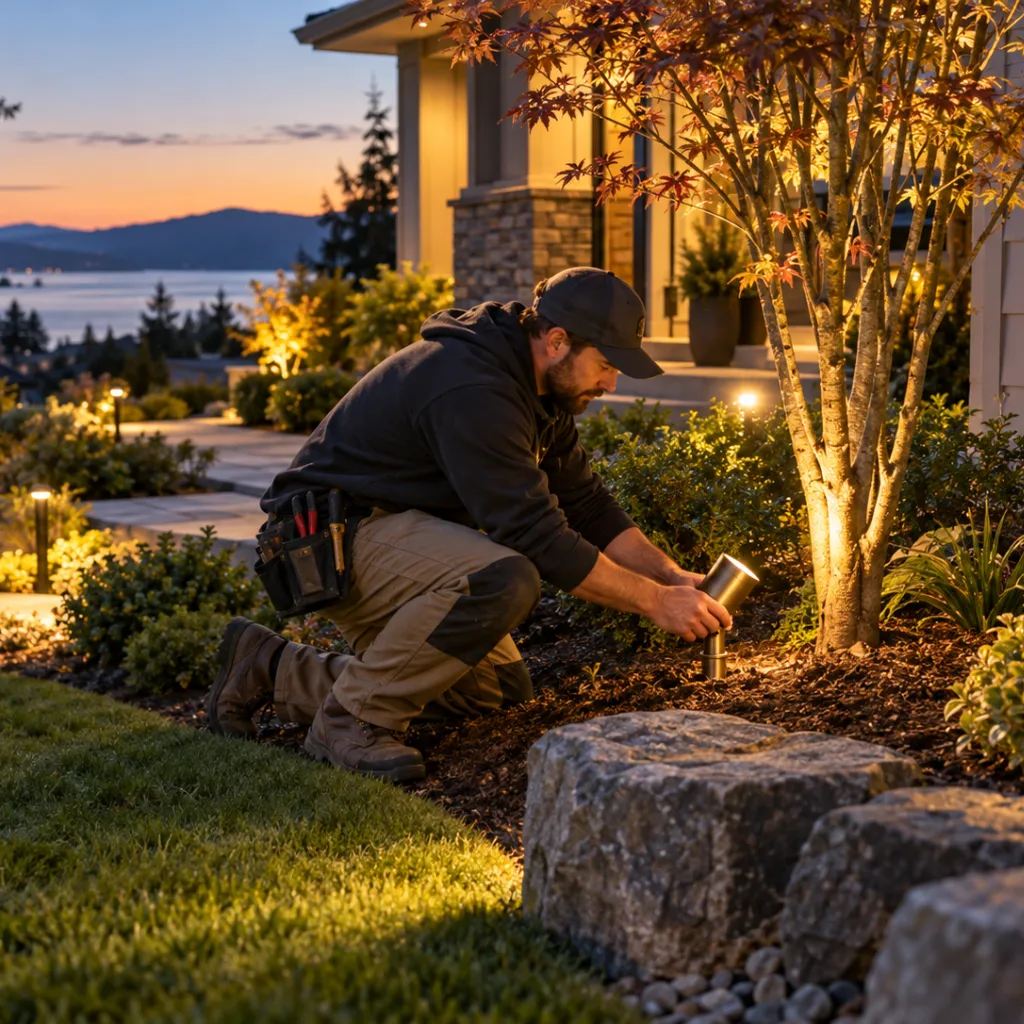
- Uplights aimed into trees, walls or tall shrubs
- Downlights mounted high, so light falls like moonlight
- Wall and step lights built into hardscape
- Wash and graze lights for stone, fences and house walls
How does path and uplighting change through the seasons?
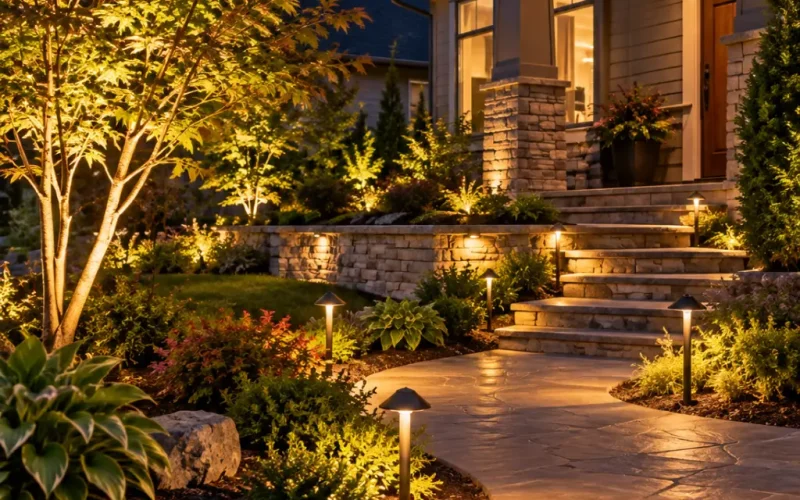
The most changeable of our lighting is the uplights. The path lights are virtually unchanged but both go well together.
The path lights provide consistent lighting throughout the year. They’re simply there to indicate where to walk so their positioning will be related to the path rather than the plants. However, the uplights provide lighting for anything above them. This becomes very different in a deciduous tree between July and January.
Garden feature | Summer effect | Winter effect | Design tip |
Japanese maple or dogwood | A glowing leaf canopy | A sculptural branch silhouette | Place the light close to the trunk so branches read in winter |
Douglas fir or cedar | Dark, deep green mass | The same, plus wet bark texture | Light from a few feet out to show trunk and lower limbs |
Rhododendron and azalea beds | Flowers and foliage | Glossy evergreen leaves | Use low, wide lights instead of strong spots |
Ornamental grasses | Soft, airy movement | Tan seed heads and stems | Backlight them so they glow |
Stone walls and steps | Warm texture | Wet surfaces that sparkle | Graze the face from close range |
That’s also the honest answer to where should landscape lights be placed: where they’ll still look good in January. A fixture that only works with full summer foliage spends half the year lighting nothing.
For spacing and brightness on walkways, our pathway lighting guide breaks down the numbers.
What makes low voltage landscape lighting suit a changing year?
Its controls. Low voltage landscape lighting runs through a transformer that steps household power down to a safer level, and modern transformers handle timing and zones well.
Day length is the reason that matters here. Portland’s evenings swing from long summer twilight to early winter darkness. As a result, a simple fixed timer either switches on too early in summer or too late in winter.
A good system solves that in three ways:
- Astronomical or photocell timers that follow sunset automatically
- Separate zones, so path lights stay on longer while accent lights shut off earlier
- Spare transformer capacity for plants that grow and fixtures you’ll add later
Homeowners also ask, “Is low voltage lighting worth it?” We have great control in Portland. This means you can operate lots of fixtures at low power, you can also control the brightness of different zones and even change the timing without any wiring.
If you’re comparing installers, our guide to choosing a landscape lighting pro covers transformers, wiring and quotes.
What does good garden lighting design leave dark?
Lighting schemes in the garden are all about creating contrast. Dark areas are just as important as lit areas.
Over-lighting will flatten the garden and create issues outside your boundary. The City of Portland’s dark skies presentation lists glare, skyglow and light trespass as parts of light pollution. It also notes that blue-rich white light suppresses melatonin, which is one more reason to favor warm color temperatures.
Wildlife is part of the picture too. Oregon State University Extension points out in its outdoor lighting video that moths, which pollinate at night, are drawn to landscape lights. Its advice is simple: use timers or motion sensors, and aim fixtures down rather than up into the sky.
In practice, that means a few habits:
- Shield every fixture so you see the effect, not the bulb
- Aim uplights into a canopy, not past it into open sky
- Choose warm white light for most of the garden
- Turn accent zones off later in the evening
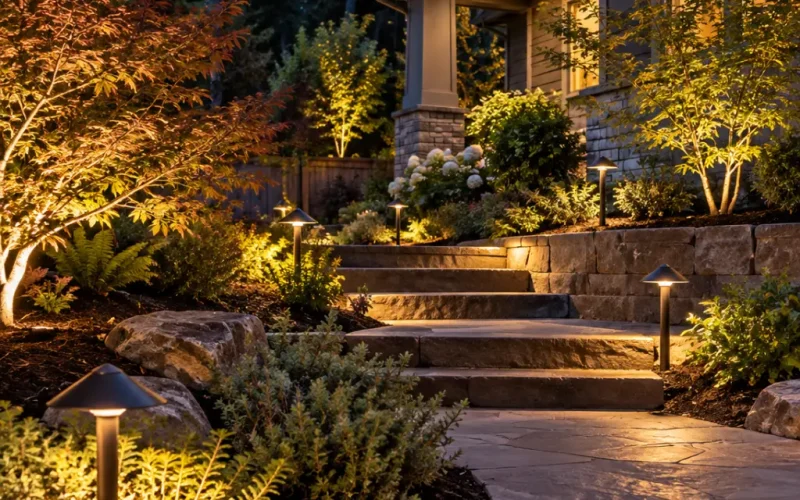
Where do we design lighting around Portland, Beaverton and Sherwood?
We design and install lighting throughout the Portland metro area. This includes inner city areas of Portland and the West side suburbs of Portland. We cover Portland, Beaverton, Sherwood, Lake Oswego, Tualatin and West Linn.
If you’ve been searching for outdoor landscape lighting Portland OR, we’re happy to walk your yard after dark. We also share landscape lighting ideas for yards near Beaverton and Sherwood Oregon, where many lots mix mature evergreens with newer plantings.
And if you searched for low voltage lighting design Portland metro OR, see our local pages for Portland, Beaverton and Sherwood. Our Sherwood lighting designer guide also explains how design and installation fit together.
How do you start a lighting design with Grover’s?
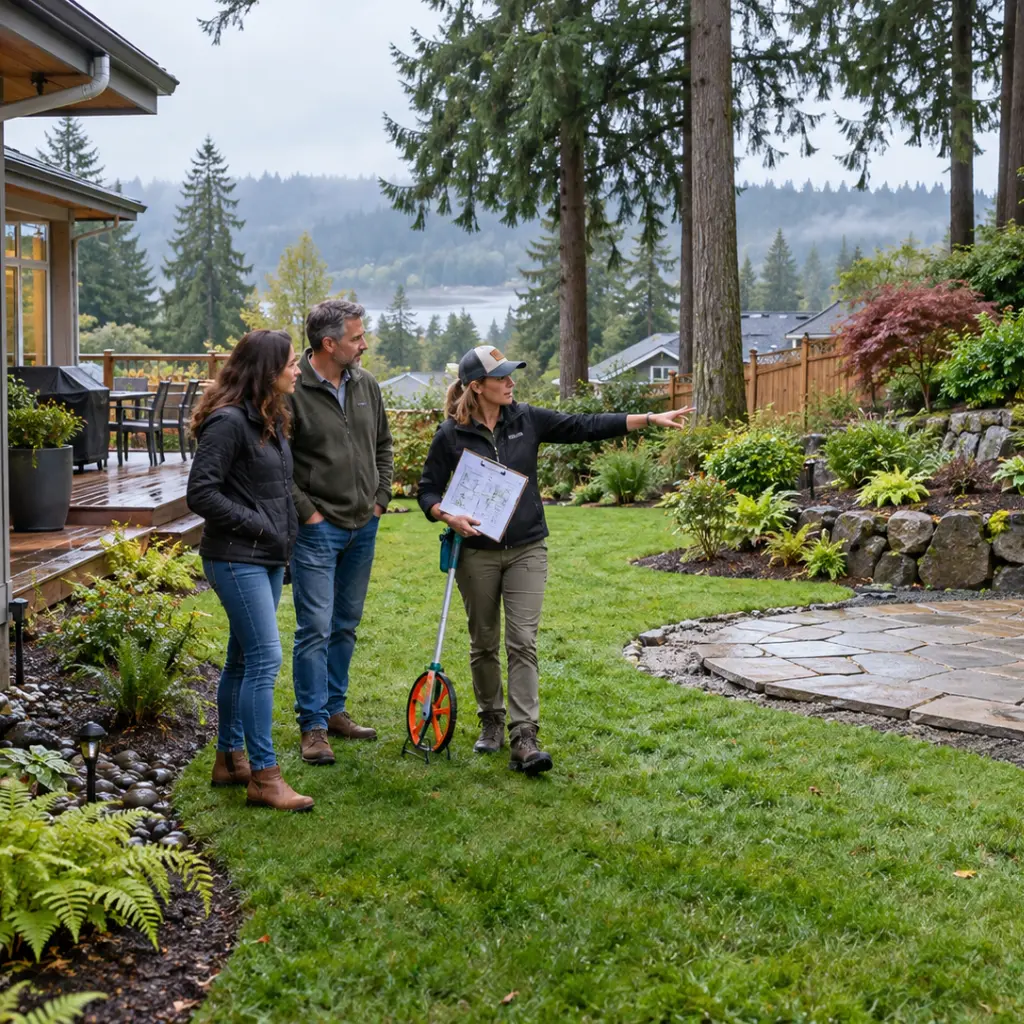
We’ll come over after you give us a ring or have a quote. It’s helpful if some of our time is towards the end of day so we can see how much darkness your yard will experience and what areas need lighting.
A report will then be provided showing where the fittings will go, areas and timer settings. Quality outdoor landscape lighting should look good on a January evening. To get started, request a free quote or call (503) 936-8910. You can also learn more about our landscape lighting services.
Frequently Asked Questions
Which outdoor lighting types suit a Portland garden?
Most gardens would work well with a combination of path lighting, up lighting and a few down lights. The path lighting can provide safe lighting, up lighting will highlight the trees and down lights placed in large evergreens will create a nice soft moonlight effect. Wall and step lighting will work well if they have stone or hard landscaping.
Where should lights go for paths, steps and trees?
Path lighting will usually be placed slightly away from the path itself, often offset. Step lighting will be best placed on the step itself, either on the rise or side wall to illuminate all the treads. Tree lighting will be best placed close to the trunk for deciduous trees and a little further out for large conifers.
Does outdoor lighting survive a wet Oregon winter?
Yes! As long as you have a good quality system. With solid brass or copper fittings, sealed connectors and proper buried cables, they will cope well with the constant rain. Cheaper fittings and twist connectors will often be the first things to fail.
Is low voltage or solar better in the Pacific Northwest?
Most of the time low voltage is the best option. Solar lighting will not get charged during the day and during the short, cloudy winters many will be dim or off by half way through the evening. Hard wired low voltage will provide consistent lighting throughout the winter. You can also use timers and zones.
How much lighting is too much for one backyard?
Too much lighting can make your garden look flat, too bright and cause glare onto your neighbours windows. Most back gardens will look best with just a few strategically placed features. If you can see the bulbs more than the garden then the design needs less or dimmer lighting.
When is the best time of year to install landscape lighting?
Late summer and early autumn are good times to fit your lighting as the ground will be dry and your lighting will be ready for the darker months. However it can be fitted at any time of year. During the winter you can actually see exactly where you need to place your lighting.
What color temperature looks best in a garden?
Warm white (often 2700K – 3000K) will work best in most gardens. This will compliment the warm glow from your windows. Cool lighting can cause plants to look harsh and add more blue tones to your night. Sometimes a slightly cooler tone can work well with silver leaved plants or water features.
How often does a landscape lighting system need maintenance?
A quick check once or twice a year is usually enough. Plants grow and block fixtures, so lights often need re-aiming. It’s also worth cleaning lenses, checking connections and updating timers as the seasons shift.
Visit or Call Us
Grover’s Landscape Services & Design Serving Portland and surrounding metro communities Phone: (503) 936-8910 Email: groverslandscapevwl.design@gmail.com Hours: Monday to Friday, 8:00 a.m. to 5:00 p.m. License: Oregon CCB #100592 Family-owned since 1995. Serving Portland, Beaverton, Sherwood, Lake Oswego, Tualatin, West Linn, Wilsonville and nearby communities.