
What Should a Commercial Landscape Contract Include?
Category Commercial Landscaping
What Should a Commercial Landscape Contract Include?
Commercial landscape maintenance Wilsonville OR property managers and HOA boards rely on operates very differently from a residential lawn care arrangement. The contract structure, insurance requirements, and inspection cadence all reflect the liability and scale of managing shared or commercial property, not a single homeowner’s yard. Grover’s Landscape Services & Design has provided commercial and HOA landscape maintenance throughout Wilsonville and the Portland metro since 1995.
By Yuriy Cheshev, Owner · Last updated 30 June 2026
What Should a Commercial Landscape Contract Include?
A commercial landscape contract is the first thing we walk through with every property manager, HOA board, or facilities director before submitting a proposal. A properly structured contract protects both parties and sets clear expectations from day one. Here’s what it should cover.
Scope, Frequency, and Response
Detailed scope of services. This means mowing frequency, edging, bed maintenance, irrigation management, pruning schedule, fertilization program, and pest or weed control. Spell out each one specifically, rather than referencing them loosely as “full-service maintenance.” In fact, ambiguous scope language is the single most common source of disputes between property managers and landscape contractors.
Service frequency by season. Oregon’s climate requires a different visit cadence across the year: weekly in spring and summer, reduced frequency in fall for cleanup-focused visits, and a defined winter schedule. That winter schedule should cover storm cleanup and any snow or ice response. In short, a contract should specify exact visit frequency for each season, not a vague “as needed” standard.
Response time commitments. For HOA landscape maintenance Portland metro communities and commercial properties alike, response time matters as much as the routine schedule. The contract should define how quickly the contractor responds to a broken irrigation head, storm debris, or a tenant complaint.
Insurance, Pricing, and Terms
Insurance and bonding documentation. Every commercial landscape contractor Oregon hires should provide a current certificate of insurance. That certificate should name the property or HOA as additional insured and confirm that liability coverage is active for the full contract term.
Pricing structure and change order process. Most commercial and HOA contracts use a fixed monthly fee for a defined scope. Alongside that, they should include a documented process for pricing out-of-scope work before the crew performs it. Examples include tree removal, irrigation repair beyond minor adjustments, and seasonal color rotation.
Term length and termination provisions. Commercial contracts typically run 12 months with renewal terms. They should also specify notice periods and the conditions for either party to exit the agreement.
Site inspection schedule. Schedule regular walk-throughs with the property manager or HOA board, not just unsupervised crew visits. They keep both parties aligned on property conditions and developing issues.
Our Maintenance Services page outlines our full residential and commercial program structure in more detail.
How Do You Bid for a Commercial Landscape Job?
Property managers ask about the bidding process when comparing proposals. A transparent process separates an established corporate landscape contractor Oregon facilities teams trust from a low-bid operation that cuts corners later.
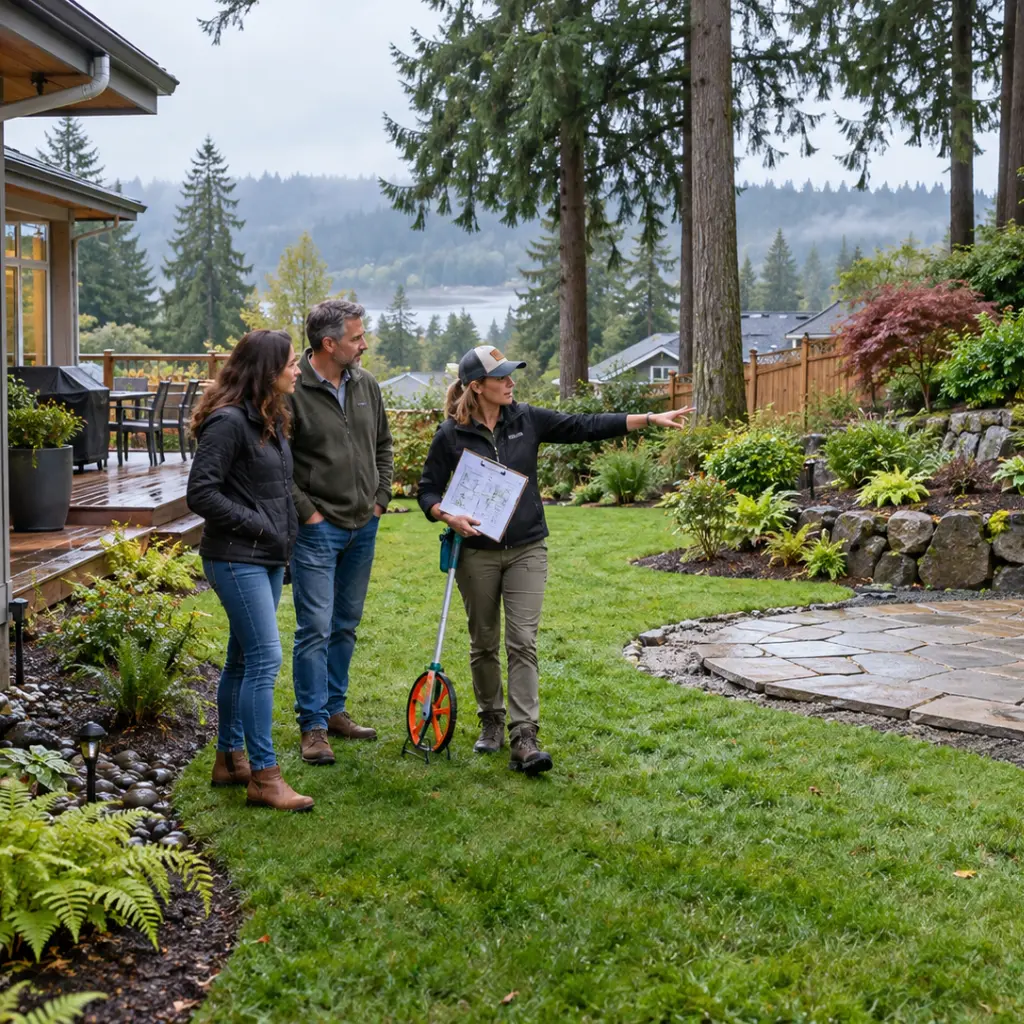
A proper commercial bid starts with an on-site walk-through of the entire property, not an aerial measurement or drive-by estimate. Specifically, we assess turf and bed square footage, irrigation zone count and condition, tree and shrub inventory, hardscape edging needs, and site challenges like slope, drainage, or heavy shade.
From there, the bid breaks into the same scope categories outlined above. We price each one individually, so the property manager or board can see exactly what’s driving the total. That beats receiving one bundled number with no breakdown. We also factor in realistic crew time per visit, based on the property’s actual conditions. A generic per-acre formula ignores Wilsonville’s specific mix of HOA common areas, retention ponds, and office park frontages.
One caution when comparing bids: a number that comes in well below competitors often means the contractor quietly reduced scope. That’s worth flagging, because the cheapest bid rarely stays cheapest once change orders for “extra” work start appearing.
What Insurance Should Commercial Landscape Contractors Carry?
Every property manager and HOA board should ask about insurance before signing. Oregon sets clear minimums, and serious commercial clients typically exceed them.
General liability. The Oregon Landscape Contractors Board requires licensed landscape contracting businesses to carry a minimum of $500,000 in commercial general liability insurance. In practice, most commercial property managers and HOA boards expect $1 million per occurrence regardless of the statutory floor. Many management companies and larger commercial properties require it as a condition of the contract.
Surety bond. Oregon LCB-licensed contractors must hold a $20,000 surety bond under ORS 671.690. That bond protects clients if a licensed contractor fails to complete contracted work or meet payment obligations.
Workers’ compensation. Oregon law (ORS 656) makes this mandatory for any landscape contractor with one or more employees. It’s non-negotiable, and a property owner who hires an uninsured contractor can be liable for on-site injuries.
Commercial auto liability. Landscape crews operate trucks, trailers, and mowing equipment on public roads daily. So $500,000 combined single limit coverage, including hired and non-owned auto coverage, is standard for any contractor regularly transporting equipment to commercial sites.
Pesticide/chemical application coverage. If fertilizer, herbicide, or pesticide application is part of the contracted scope, standard general liability typically excludes pollution-related events. Before any chemical treatment, confirm two things: a separate pollution liability endorsement, and a valid Oregon Department of Agriculture commercial pesticide applicator license.
Grover’s carries coverage that meets and exceeds these standards. We provide a current certificate of insurance to any commercial client or HOA board before work begins.
How Much Does Commercial Landscape Maintenance Cost?
Commercial landscape maintenance cost varies significantly based on property size, scope, and visit frequency. There’s no reliable flat per-acre number that applies across different property types.
HOA common-area maintenance: Typically $300–$1,200 per month for a standard residential HOA in the Wilsonville area. The range depends on acreage, amenity features like entry monuments or retention pond landscaping, and visit frequency.
Small office park or commercial property: $400–$1,500 per month for properties with modest turf and foundation plantings. This scales with square footage and planted-area complexity.
Larger corporate campus or multi-building property: $1,500–$5,000+ per month. Here the number depends on total acreage, irrigation complexity, and whether the contract includes seasonal color rotation, tree care, and snow/ice response.
A few factors push cost up across all property types. Those are irrigation system age and complexity, the ratio of bed area to turf (beds need more hand labor than mowing), and whether fertilization, pest control, or seasonal color programs are standard scope rather than add-ons.
Contact us for a property walk-through and a detailed, itemized commercial proposal.
Can Commercial Landscape Maintenance Be Done Year-Round in Oregon?
Yes, and for commercial and HOA properties it generally should be. Deferred maintenance during Oregon’s wet season creates more expensive problems by spring. The nature of the work simply shifts seasonally rather than stopping.
Spring and summer: Weekly mowing, active irrigation management, and regular bed maintenance dominate the schedule.
Fall: Leaf cleanup, aeration, overseeding, and fertilization ahead of the wet season become the priority. Irrigation system shutdown happens as the season transitions.
Winter: Storm debris cleanup, moss treatment on hardscape and turf areas, and ongoing site inspections continue through the mild Oregon winter. Any snow or ice response activates as needed.
How often should commercial properties be serviced? Most contracts in the Wilsonville area run weekly visits April through October, then bi-weekly or monthly November through March. The contract should specify the exact cadence rather than leave it to interpretation.
How Often Should Commercial Properties Be Inspected?
Inspection frequency depends on property complexity, but a baseline works for most Wilsonville-area commercial and HOA properties. That baseline is a formal monthly walk-through with the property manager or board representative, supplementing the routine maintenance visits where the crew flags issues as they notice them.
Some properties carry higher liability exposure — retention ponds, mature trees near parking areas or building entrances, or steep slopes. For those, more frequent dedicated inspection, separate from routine maintenance, helps catch developing hazards early. A leaning tree, an eroding slope, or failing irrigation causing standing water is far cheaper to address before it becomes a safety or liability issue.
Wilsonville and Portland Metro Commercial Properties We Serve
Grover’s Landscape Services & Design is one of the best commercial landscape companies near Wilsonville OR, with three decades of Portland metro experience. We manage HOA, office park, and corporate landscape contracts across Clackamas and Washington counties.
Property managers and HOA boards often search for top-rated HOA landscape contractors in the Portland metro. Our long client retention reflects consistent, accountable service rather than a revolving door of new accounts replacing dissatisfied ones. We serve properties throughout Wilsonville, Tualatin, Sherwood, Lake Oswego, Tigard, Oregon City, and Milwaukie.
Which commercial landscape contractor is best for office parks in Oregon often comes down to one factor. Does the contractor handle full scope in-house — design, irrigation, hardscape, ongoing maintenance — rather than subcontracting pieces out and losing accountability? Grover’s is the commercial lawn care Clackamas County property managers rely on, and one of the corporate landscape contractors Oregon facilities teams call repeatedly. We keep the same crew accountable for a property across seasons and contract years.
Our full services page maps out the complete range we bring to commercial accounts. Our residential landscape maintenance guide covers our approach for single-family properties, if you’re researching options for a personal residence alongside a commercial inquiry.
Frequently Asked Questions
What is included in a commercial landscape contract?
A commercial landscape contract should include several core elements. These are a detailed scope of services (mowing, edging, bed care, irrigation, pruning, fertilization, and pest control), service frequency broken out by season, and defined response times for reported issues. It should also cover insurance and bonding documentation, a fixed pricing structure with a change-order process, term length and termination provisions, and a regular site inspection schedule. The most important element is specificity — vague “full-service maintenance” language is the leading cause of disputes between property managers and contractors.
How do you bid for a commercial landscape job?
A proper commercial bid begins with an on-site walk-through of the entire property, not an aerial or drive-by estimate. The contractor assesses turf and bed square footage, irrigation zone count and condition, tree and shrub inventory, hardscape edging needs, and site challenges like slope and drainage. The bid is then itemized by scope category so the property manager can see what drives the total. Be cautious with bids that come in far below others — a low number usually signals reduced scope that reappears later as change orders.
What insurance should commercial landscape contractors carry?
At minimum, an Oregon commercial landscape contractor should carry four coverages. Those are general liability (the LCB requires $500,000; most commercial clients expect $1 million per occurrence), a $20,000 surety bond under ORS 671.690, workers’ compensation for any business with employees (ORS 656), and commercial auto liability of at least $500,000 combined single limit. If the scope includes chemical application, the contractor should also carry a pollution liability endorsement and hold a valid Oregon Department of Agriculture pesticide applicator license. Always request a current certificate of insurance naming your property as additional insured before signing.
Can commercial landscape maintenance be done year round in Oregon?
Yes, and for commercial and HOA properties it generally should be. The work shifts by season rather than stopping. Spring and summer center on weekly mowing and irrigation. Fall shifts to leaf cleanup, aeration, overseeding, and fertilization before the ground saturates. Winter covers storm cleanup, moss treatment, and site inspections through the mild Oregon off-season. Skipping winter care in western Oregon typically means starting spring with heavier moss, weed establishment, and compaction. Those problems cost more to correct than to prevent.
How often should commercial properties be inspected for landscape issues?
For most Wilsonville-area commercial and HOA properties, a formal monthly walk-through with the property manager or board representative is the baseline. That’s on top of the routine maintenance visits, where the crew flags issues as they arise. Properties with higher liability exposure — retention ponds, mature trees near parking or entrances, or steep slopes — benefit from more frequent dedicated inspections. The goal is catching developing hazards like a leaning tree or failing irrigation before they become safety or liability problems.
Contact Grover’s Landscape Services & Design
Grover’s Landscape Services & Design Serving Portland and surrounding metro communities Phone: (503) 936-8910 Hours: Mon–Fri 8:00 AM – 5:00 PM Oregon CCB #100592 · Licensed & Insured · Family-Owned Since 1995
Serving Wilsonville, Lake Oswego, Tigard, Tualatin, Sherwood, King City, Milwaukie, Oregon City, and communities throughout Clackamas and Washington Counties.