
Paver Patio Installation in Clackamas, OR: 2026 Guide
Category Patios
Paver Patio Installation in Clackamas, OR: 2026 Guide
Professional Paver Patio Installation Clackamas OR homeowners choose for outdoor living spaces runs $18 to $42 per square foot installed. In Clackamas County’s wet climate, a properly built paver patio outlasts poured concrete, drains better, and stays repairable in ways a slab never is. Grover’s Landscape Services & Design is a licensed Paver Patio Contractor Clackamas County families trust (Oregon CCB #100592), with a 4.8-star rating and extensive Clackamas and Portland metro hardscape experience.
By Yuriy Cheshev, Owner · Last updated 23rd June 2026
A paver patio is one of the most used and most visible investments in a Clackamas County outdoor space. In other words, it’s the surface where outdoor dining, entertaining, and relaxing actually happens. In Oregon’s wet climate, the material and installation decisions matter more than they do in drier markets. Specifically, a paver system installed on an inadequate base in Clackamas County’s clay soils will shift, settle, and heave within a few seasons. This guide covers what a paver patio is, what it costs, how long it lasts, how it compares to concrete, and what the installation process looks like.
What Is a Paver Patio?
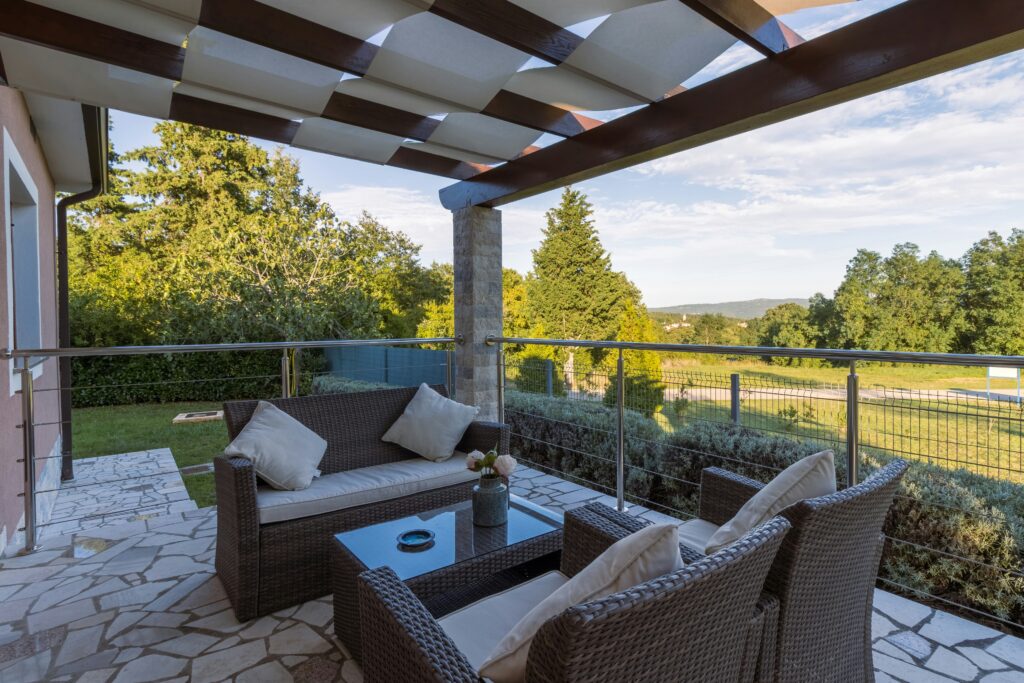
When clients ask what a paver patio is, the answer is straightforward. It’s a ground-level outdoor surface constructed from individual interlocking paving units — concrete pavers, clay brick pavers, or natural stone — set on a prepared aggregate base rather than poured as a monolithic slab. Notably, the individual units interlock or sit with small gaps between them. As a result, they create a flexible system that distributes loads and accommodates movement without cracking.
Also here’s what makes a paver patio different from poured concrete in practice:
Repairability. Individual pavers can be lifted, the base corrected, and the paver reset. Alternatively, a single damaged paver can be replaced without affecting the rest of the surface. By contrast, a cracked concrete slab requires patching that never matches, or cutting out and replacing an entire section.
Drainage. Paver joints allow water to infiltrate between units rather than sheet across the surface. In Clackamas County’s winter rainfall, this benefit reduces surface water accumulation and slip hazard.
Freeze-thaw performance. For instance, Clackamas County typically sees 20–30 freeze-thaw cycles per winter. The flexible paver system absorbs thermal movement that would crack a rigid slab. As a result, paver patios consistently outlast poured concrete in western Oregon’s climate.
Aesthetic flexibility. Pavers come in running bond, herringbone, basket weave, and random patterns. In addition, pattern changes define zones within a larger outdoor space — a dining area in one direction, a lounge zone in another — without structural changes.
How Much Does a Paver Patio Cost?
Also here’s what paver patio installation costs in Clackamas and the Portland metro in 2026:
Paver type | Installed cost (per sq ft) |
Concrete pavers (standard) | $18 – $28 |
Concrete pavers (premium large-format) | $24 – $35 |
Clay brick pavers | $22 – $38 |
Tumbled or textured natural concrete | $20 – $32 |
Natural stone (basalt, bluestone) | $30 – $55+ |
For a typical Clackamas County patio of 300–500 sq ft:
- Concrete pavers, 350 sq ft: $6,300 – $12,250
- Clay brick pavers, 350 sq ft: $7,700 – $13,300
- Natural stone, 350 sq ft: $10,500 – $19,250+
The Clackamas County premium over national averages reflects several factors. These include Oregon labor rates, the 6-inch minimum aggregate base depth required for our wet climate and clay soils (versus the 4-inch standard in drier markets), geotextile drainage fabric under the base, and edge restraint installation. In short, a properly built paver patio in Clackamas County costs more than the national average, but it lasts significantly longer.

How Long Do Paver Patios Last?
Here’s how long paver patios last in western Oregon’s climate:
- Concrete pavers: 25–50 years with appropriate maintenance (periodic joint sand replenishment, edge restraint integrity checks)
- Clay brick pavers: 50–100 years — the most durable option for color stability and material longevity, because clay brick doesn’t fade in UV
- Natural stone: 50+ years; the basalt and bluestone used in Oregon are among the most durable paving materials available
There’s one important longevity caveat: a paver patio lasts as long as its base. For example, a concrete or clay paver set on an inadequate base in Clackamas County’s clay soils will heave and settle within 5–10 years, regardless of the surface paver’s inherent durability. Per the Interlocking Concrete Pavement Institute (ICPI), a properly installed paver system in wet-climate conditions requires three things: a compacted aggregate base of at least 6 inches, appropriate geotextile fabric to prevent clay migration into the base, and edge restraints that prevent base movement. These aren’t premium add-ons. Instead, they’re the baseline for a patio that will last.
Paver Patio vs. Concrete — Which Is Better?
In addition for Clackamas County homeowners comparing paver patio vs. concrete, here’s the honest breakdown.
Where Concrete Wins
Cost. Poured concrete wins upfront. For example, a basic broom-finish concrete patio runs $10–$18 per sq ft installed in the Portland metro, significantly less than pavers at $18–$35. However, the cost gap narrows when comparing to stamped or exposed aggregate concrete.
Heavy loads and large flat areas. Concrete is the right choice for large flat areas where cost is the primary constraint, or for areas that carry heavy loads. For instance, vehicle traffic in driveways is more typically served by concrete than pavers in most residential applications.
Where Pavers Win
Longevity. Because poured concrete in western Oregon’s wet-dry freeze-thaw environment typically shows cracking within 5–15 years. A properly installed paver system, by contrast, lasts 25–50+ years. So the long-term cost calculation often favors pavers over 20+ years.
Repairability. Pavers win decisively here. A single heaved or damaged paver can be lifted and reset. A cracked slab, meanwhile, requires patching that discolors or cutting that’s disruptive and expensive.
Drainage. In wet climates, the infiltration between paver joints reduces surface runoff in Oregon’s rainy season. That’s particularly relevant on slopes or near the home’s foundation.
Aesthetics. Concrete offers broom finish, exposed aggregate, or stamped options. By comparison, pavers offer dozens of shapes, colors, and patterns that concrete can’t replicate.
Overall, for a patio in Clackamas County, pavers are the better long-term choice for most homeowners.

Best Paver Patio Installer in Clackamas, OR — What to Look For
What distinguishes the Best Paver Patio Installer in Clackamas OR from a contractor who just lays pavers on a thin base? A few things.
Base depth and soil knowledge. Clackamas County’s Willamette silt loam is a moderately expansive clay-based soil. It’s not the worst in Oregon, but it’s far more problematic than sandy soil for paving. So an experienced Patio Paver Installer Portland Metro area knows that ICPI’s 4-inch minimum for good drainage soil is insufficient for Clackamas County conditions. For that reason, we specify a 6-inch compacted aggregate base as standard.
Geotextile drainage fabric. Specifically, fabric between the native subgrade and the aggregate base prevents clay fines from migrating upward into the base over time. This process, called pumping, degrades the base from below without being visible until the patio starts to rock. Fortunately, the fabric is a one-time installation that protects a multi-decade patio. It adds $0.50–$1.00 per sq ft and is always included in our base spec.
Proper edge restraint. The paver system must be contained along all edges with a permanent restraint — either a concrete-pinned plastic edge restraint or a concrete border course. Without it, the base migrates outward and pavers spread apart over time. In fact, this is one of the most visible paver failure modes in Clackamas County.
Oregon licensing. Any Contractor for Paver Patios Clackamas County should be licensed with the Oregon Construction Contractors Board. So verify our license (Oregon CCB #100592) and any other contractor’s license before signing a contract.
Paver Patio Installation Near Me Portland — Permits and Process
Additionally, as a Paver Patio Installation Near Me Portland resource serving Clackamas and surrounding communities, here’s the permit and process picture.
Permits. Ground-level paver patios typically don’t require a building permit in Clackamas County, as long as they don’t affect drainage patterns above the threshold that triggers stormwater review. Projects adding more than 500 sq ft of new impervious surface may trigger stormwater review, per Clackamas County Building Division guidelines. In practice, we assess this at design for larger patio projects.
Installation sequence:
- Site marking and excavation: Excavate 8–10 inches below finished grade (6-inch base + 1-inch bedding sand + paver thickness of 2.5–3.5 inches)
- Geotextile fabric installation: Laid over the compacted subgrade to prevent clay migration
- Base compaction: 6-inch aggregate base installed in two 3-inch lifts, each compacted with a plate compactor to 98% Proctor density
- Bedding sand: 1 inch of coarse bedding sand screeded to grade
- Paver setting: Pavers set to pattern, joints maintained with spacers or hand spacing
- Edge restraint installation: Pinned to the compacted base on all perimeter edges
- Compaction and joint sand: Plate compacted, polymeric joint sand swept and vibrated in, final compaction
Timeline. A 300–500 sq ft paver patio in Clackamas County takes 3–5 working days. That breaks down to 1 day for excavation and base prep, 1 day for fabric and base compaction, 1 day for bedding and paver setting, and a half to full day for edging, joint sand, and cleanup.
Frequently Asked Questions
What is a paver patio and what are the benefits?
A paver patio is a ground-level outdoor surface built from individual interlocking paving units — concrete, clay brick, or natural stone — set on a compacted aggregate base. Benefits over poured concrete in Clackamas County: individual units are repairable without disrupting the full surface, joints allow water infiltration that reduces runoff in Oregon’s rainy season, and the flexible system absorbs freeze-thaw movement that cracks rigid slabs.
How much does a paver patio cost in Clackamas, OR?
In 2026, paver patio installation in Clackamas runs $18 to $28 per sq ft for standard concrete pavers, $22 to $38 for clay brick, and $30 to $55 or more for natural stone. For a 350 sq ft patio, that’s $6,300 to $12,250 for concrete pavers and $7,700 to $13,300 for clay brick. The Clackamas County cost premium over national averages reflects 6-inch base depth, drainage fabric, and Oregon labor rates.
How long do paver patios last?
Concrete pavers last 25 to 50 years with appropriate maintenance. Clay brick pavers last 50 to 100 years with lifetime color stability. Natural stone lasts 50-plus years. Longevity depends on base quality — a paver patio is only as durable as the base it sits on. Proper 6-inch aggregate base with drainage fabric in Clackamas County’s clay soils is the baseline for 25-plus-year performance.
Paver patio vs. concrete — which is better?
For Clackamas County patios, pavers are the better long-term choice. Poured concrete costs less upfront ($10 to $18 per sq ft vs. $18 to $35) but cracks within 5 to 15 years in Oregon’s freeze-thaw environment. Pavers last 25 to 50-plus years, are individually repairable, and drain better in wet conditions. Over a 20-plus-year horizon, pavers are typically more economical, and they look better throughout.
How long does paver patio installation take?
A 300 to 500 sq ft paver patio in Clackamas County takes 3 to 5 working days: 1 day for excavation and base preparation, 1 day for drainage fabric and compacted aggregate base, 1 day for paver setting, and up to 1 day for edge restraint, joint sand, and cleanup. Larger patios or projects with complex patterns or integrated steps take longer.
Contact Us
Grover’s Landscape Services & Design Lake Oswego, OR Phone: (503) 936-8910 Oregon CCB #100592 | Licensed & Insured | 4.8-Star Rated
Serving Clackamas, Lake Oswego, Oregon City, Happy Valley, and the Portland metro south corridor.
Request a free paver patio estimate or call (503) 936-8910.