
Water Feature Installation in Clackamas, OR: 2026 Guide
Category Water Feature Installation
Water Feature Installation in Clackamas, OR: 2026 Guide
When homeowners search for water feature installation near me Portland or water feature installation Clackamas OR, they want one thing. That’s a contractor who understands both the design and the Pacific Northwest climate context. Grover’s Landscape Services & Design is a licensed Clackamas County landscape contractor (Oregon CCB #100592) with a 4.8-star rating. We design and install water features throughout the Portland metro, from simple container fountains to full ecosystem ponds.
By Yuriy Cheshev, Owner · Last updated 17th June 2026
Western Oregon’s mild winters, reliable moisture, and naturalistic design aesthetic make Clackamas County an ideal environment for water features. Specifically, pumps don’t dry out during seasonal drought, and naturalistic stream and pond designs align with the region’s existing landscape character. In addition, moderate freeze risk makes year-round operation feasible with the right equipment. Temperatures rarely drop below 20°F for sustained periods here. So this guide covers what water features are available, what they cost in the Clackamas area, how they’re maintained, and what the permit picture looks like.
Also for our broader outdoor living design services, see our landscape design guide.
What Is a Water Feature?
When homeowners ask what a water feature is, the answer covers a wide range of installations. In residential landscaping, it’s anything that incorporates water movement, circulation, or containment as a design element. The term encompasses:
- Ponds — contained bodies of water, with or without fish, typically with a filtration system and aquatic plants
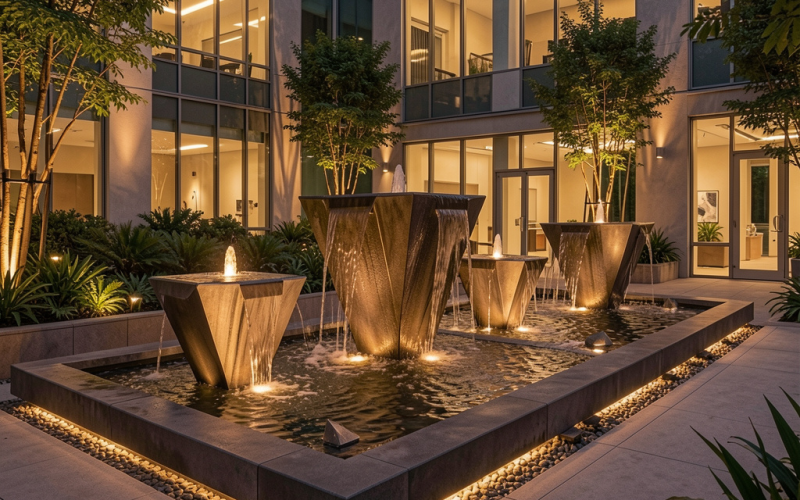
- Fountains — decorative water circulation systems ranging from simple container features to elaborate tiered stone installations
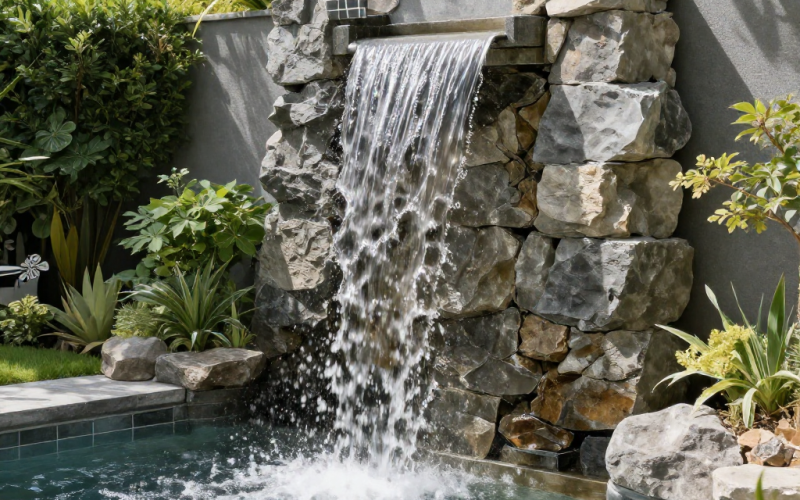
- Waterfalls — water flowing over rock structures, typically fed by a pump and recirculating basin
- Pondless waterfalls — waterfalls that disappear into a gravel basin rather than a surface pond (lower maintenance, no standing water)
- Streams — flowing water channels connecting multiple levels or zones, often paired with a pond or pondless basin
- Bubblers — small self-contained features (often a boulder or millstone) with water emerging from the surface and disappearing into an underground reservoir
Plus a well-designed water feature adds three things: the sound of moving water, wildlife habitat value (birds and beneficial insects arrive immediately), and a naturalistic focal point. Together, they transform the character of an outdoor space. As the best water feature installer in Clackamas OR, Grover’s Landscape designs each feature to feel like it belongs in the Pacific Northwest landscape. It should never look like a decorative afterthought.
What Types of Water Features Are There?
Here are the types a Clackamas County homeowner can commission, from simplest to most complex.
Container Fountains and Bubblers
First, these are the entry-level water feature: a self-contained pump, reservoir, and decorative element such as a stone boulder, ceramic vessel, or millstone. Installation takes a few hours and requires a nearby 120V outlet, and you can relocate the feature if needed. As a result, they’re ideal for small gardens, patios, or as a first water feature.
Pondless Waterfalls
Next, this is the most popular residential installation in the Portland metro market. In practice, water flows down a rock structure into a buried basin filled with gravel and a submersible pump, then recirculates. There’s no standing pond to maintain, no safety concerns with open water, and the sound quality of a waterfall without the full ecosystem pond commitment. In fact, as a pond and fountain installer Portland metro, we install more pondless waterfalls than any other type.
Ecosystem Ponds
By contrast, an ecosystem pond is a fully contained aquatic ecosystem: fish-grade liner, pump and filtration (skimmer plus biological filter), aquatic plants, and optional Koi or goldfish. Notably, properly designed ecosystem ponds are largely self-regulating, because aquatic plants and beneficial bacteria handle biological filtration and reduce chemical maintenance needs. Aquascape is the industry-leading ecosystem pond system manufacturer, and their contractor network and installation standards are what most professional Clackamas water feature contractors follow.
Formal Fountains
By contrast, these are tiered stone or cast concrete fountains for formal garden contexts, typically installed on a prepared concrete base with a recirculating pump and basin. They’re common in Lake Oswego and Clackamas County’s more formal estate-style properties.
Stream Systems
Finally, stream systems are naturalistic flowing water channels that connect a waterfall head to a pond or pondless basin across a landscape area. They’re designed to look like a naturally occurring stream, with rock placement and aquatic planting integrated into the stream bed.
How Much Does a Water Feature Cost?
Here’s what a water feature costs in the Clackamas and Portland metro market in 2026:
Type | Installed cost range |
Container fountain / bubbler | $800 – $2,500 |
Pondless waterfall (small) | $3,500 – $7,000 |
Pondless waterfall (medium) | $6,500 – $14,000 |
Ecosystem pond (small, 200 sq ft) | $8,000 – $16,000 |
Ecosystem pond (medium, 400–600 sq ft) | $14,000 – $28,000 |
Stream system | $6,000 – $20,000+ |
Formal fountain | $4,000 – $12,000 |
As a water feature contractor Clackamas County, we see strong demand for mid-range pondless waterfalls ($6,000–$12,000) and ecosystem ponds ($10,000–$20,000) in the Clackamas and Lake Oswego market. In short, these price points hit the sweet spot. These price points deliver high landscape impact and manageable ongoing maintenance.
Generally, the installed cost includes excavation, liner and underlayment, pump and filtration system, rock and gravel, electrical connection, and plant material for aquatic planting zones. Rock sourcing significantly affects the total. For example, locally quarried basalt (the dominant rock in Clackamas County landscapes) is more available and affordable than imported stone, and it looks more natural in the Pacific Northwest context.
Best Water Feature Installer in Clackamas, OR — What to Look For
Also when evaluating the best water feature installer in Clackamas OR, look for three things.
Clackamas County permit experience. However according to the Clackamas County Building Division, ponds and large excavation projects require county and state approval, and electrical permits are required for pump wiring. Therefore, a qualified water feature contractor handles both the building/excavation and electrical permit applications as standard, not as an add-on.
Ecosystem pond design knowledge. A quality contractor understands several things: biological filtration, aquatic plant selection for Zone 8b (the Clackamas County USDA hardiness zone), pump sizing for the specific head height and flow rate needed, and winterization requirements for the Portland metro climate.
Naturalistic design sensibility. Water features in the Clackamas and Portland metro market should look like they emerged from the Pacific Northwest landscape. That means basalt rock placement, native aquatic plants (iris, sedge, rushes), and naturalistic form rather than symmetrical or overly manicured design.
Do Water Features Need a Permit in Clackamas, OR?
Specifically yes, in several scenarios. Per Clackamas County Building, here’s how it breaks down.
Ponds and large excavation. Ponds and large excavation projects require county and state approval. Also any water feature involving significant grading or excavation triggers this requirement.
Electrical work. An electrical permit is required for pump wiring before any electrical work begins in Clackamas County. Moreover, Oregon law requires a licensed electrical contractor to perform electrical work when it’s not in the homeowner’s own residence.
Waterway proximity. Clackamas County code prohibits grading, excavation, or equipment use in or near waterways without permits. This is especially relevant for stream features near natural drainage channels.
In particular, most small container fountains and bubblers (already above grade, no excavation, plug-in power) don’t require permits. As a result most pond less waterfalls and ecosystem ponds, however, do require at minimum an electrical permit for the pump circuit. In every case, we assess permit requirements as part of the project proposal and manage all applications through the county’s Development Direct system.
How Much Maintenance Does a Water Feature Require?
However maintenance requirements vary significantly by feature type, which is one of the most important factors when choosing the right water feature for your lifestyle.
Container fountains and bubblers are the lowest maintenance of any type. Typically, you top off water lost to evaporation (more in summer, minimal in winter) and clean the pump screen monthly in the growing season. Also bring the pump indoors if temperatures drop below 20°F for extended periods.
Pondless waterfalls are moderate maintenance. Here, you clean the underground basin (pump vault) once or twice per year to remove debris, then inspect the pump and restock beneficial bacteria in spring. Because there’s no sunlit standing water surface, you skip algae management entirely.
Ecosystem ponds are the most maintenance-intensive residential water feature, but well-designed ones are manageable with basic seasonal care. Also that care runs on a seasonal cycle. Spring means startup: remove debris nets, restart pump and filtration, and add beneficial bacteria. Summer means monitoring: water top-off, algae management if imbalanced, and fish feeding if present. Fall means preparation: leaf debris removal and reduced feeding as temperatures drop. Finally, winter means aerator addition to maintain gas exchange if temperatures approach freezing.
Also do you want beauty but without an extensive maintenance commitment? Then the pond less waterfall is our most recommended starting point for Clackamas homeowners.
Contractor for Ponds and Fountains in Clackamas County — Our Services
Also as a full-service contractor for ponds and fountains Clackamas County homeowners trust, Grover’s Landscape designs and installs:
- Pondless waterfalls — our most-installed feature in Clackamas County
- Ecosystem ponds — fully designed aquatic ecosystems with filtration, plants, and optional fish
- Stream systems — naturalistic water flow across landscape grades
- Container features and bubblers — a lower-cost entry point for homeowners new to water features
- Seasonal maintenance programs — spring startup, fall shutdown, and annual cleaning services
Oregon CCB #100592 | 4.8-star rated | Licensed & Insured | Portland metro specialists.
Frequently Asked Questions
What types of water features can be installed (pond, fountain, waterfall)?
Several main types suit residential Clackamas County installation. However they include container fountains and bubblers (simplest, $800 to $2,500), pondless waterfalls (most popular, $3,500 to $14,000 depending on size), ecosystem ponds with filtration and aquatic planting ($8,000 to $28,000+), stream systems, and formal fountains. Pondless waterfalls are the most popular choice in the Portland metro because they deliver waterfall sound without the full maintenance commitment of a pond.
How much does a water feature cost in Clackamas, OR?
In 2026, water feature installation in Clackamas runs $800 to $2,500 for a container fountain or bubbler, $3,500 to $14,000 for a pondless waterfall, $8,000 to $28,000 for an ecosystem pond, and $6,000 to $20,000 for a stream system. Mid-range pondless waterfalls ($6,000 to $12,000) offer the best combination of visual and sound impact for the investment in most residential Clackamas County contexts.
How much maintenance does a water feature require?
Container fountains require minimal maintenance — periodic water top-off and pump screen cleaning. Pondless waterfalls need one to two basin cleanouts per year and spring pump inspection. Ecosystem ponds require the most attention: spring startup, summer monitoring, fall leaf management, and winter prep — but well-designed ecosystem ponds are largely self-regulating through biological filtration and aquatic plant balance.
How long does water feature installation take?
A container fountain installs in a few hours. A pondless waterfall takes one to three days depending on size and rock complexity. An ecosystem pond takes three to five days. Timeline depends on excavation complexity, rock availability and sourcing, plant material scheduling, and electrical permit timing (allow one to two weeks for the electrical permit in Clackamas County). We plan all material and permit timelines before scheduling installation.
Do water features need a permit in Clackamas, OR?
Yes, in most cases beyond small plug-in features. Ponds and large excavation projects require county approval per Clackamas County code, and electrical permits are required for all pump wiring. Grading, excavation, or equipment use near natural waterways requires additional review. Small container features with plug-in power and no excavation typically don’t require permits. We assess permit requirements for every project and handle all Clackamas County permit applications.
Contact Us
Grover’s Landscape Services & Design Lake Oswego, OR Phone: (503) 936-8910 Oregon CCB #100592 | Licensed & Insured | 4.8 Stars
Serving Clackamas, Lake Oswego, and the Portland metro, including Oregon City, Happy Valley, and Milwaukie.
Request a free water feature estimate or call (503) 936-8910.