
Who Does Wetland Mitigation Services In Portland?
Category Wetland Mitigation
Who Does Wetland Mitigation Services In Portland?
Wetland mitigation services in Portland are split between the people who design and permit the site and the contractor who builds it. Grover’s Landscape Services & Design is the builder side. We construct to an approved mitigation design. That means the grading, drainage, erosion control and planting areas the plans call for, and we work alongside your consultant and engineer.
By Yuriy Cheshev, Owner · Last updated October 16, 2026
Who constructs wetland mitigation sites in Portland?
A construction contractor does, working from plans that a consultant and engineer have prepared and the agencies have approved. Who builds the wetland mitigation sites in the Portland area, and where are we at? We build, so we do not delineate wetlands, design the mitigation or write the permits. Those items are the responsibilities of your environmental consultant and the agencies, and we would rather be forth-coming that we do not do those things. We draw that line because the permits decide who is responsible for what, and the contractor can only build to the levels and elevations the permit specifies.
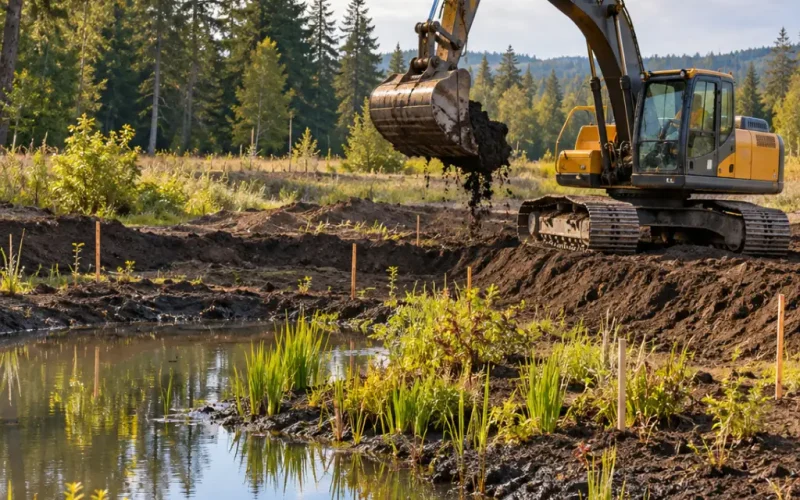
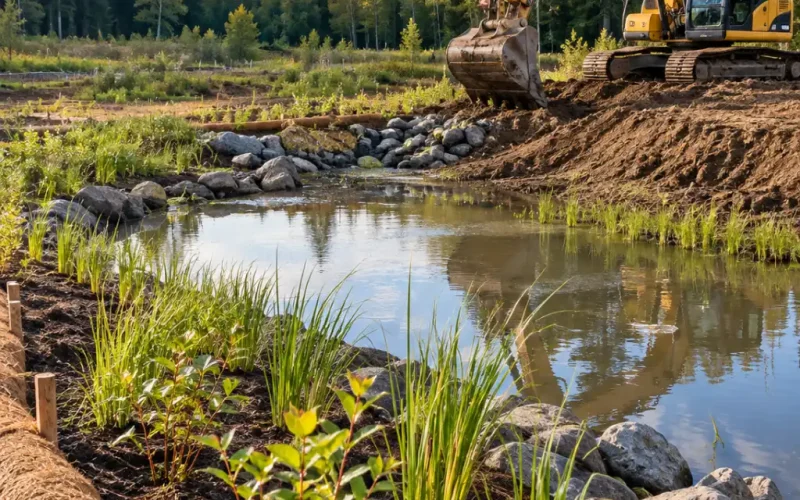
Wetland mitigation site construction Portland projects need is earthwork with a purpose. We have to shape the ground so the water behaves the way the design envisions, because the plan leaves little room for error. Our site preparation and excavation page lists the work we do: clearing, grading, excavation, drainage, soil import and export, erosion control and final grade to spec.
What is involved in building a wetland mitigation site?
It involves following the approved plan in order, from erosion control to final grade to as-built survey. Here’s the usual sequence:
- Plan review. We go through the approved drawings and specs with the consultant and engineer.
- Survey stakeout. We mark grades, limits and key elevations from survey control.
Erosion and sediment control. We install silt fence, inlet protection and other controls before we disturb any soil. - Erosion and sediment control. Silt fence, inlet protection and other controls go in before soil is disturbed.
- Clearing. We remove vegetation and debris within the approved limits only.
- Rough grading and excavation. The basic shape of the site is cut and filled.
- Hydrology features. Channels, swales, berms and outlets are built to the design elevations.
- Final grade and soil prep. The surface is finished to tolerance, and planting areas are readied.
- As-built survey. The finished site is surveyed and compared against the plan.
The federal framework also explains why the order matters. The EPA’s 2008 mitigation rule is built on a sequence of avoiding, minimizing and then compensating for impacts to aquatic resources. It also calls for monitoring after construction, so the as-built condition becomes the baseline everyone measures against.
Moreover, the timing of construction also plays an essential role. In addition, permits dictate what time of the year work can begin, and Oregon’s propensity for wet winters makes excavating difficult to complete. Therefore, budgeting work around the clockwork of the state is significantly cheaper than losing an entire season due to weather delays.
Who builds a mitigation site once the design is approved?
A contractor with earthmoving equipment, survey discipline and a willingness to follow the plan exactly. That’s the role we fill. Since the roles on a mitigation project are distinct, the table shows who does what:
Role | What they do |
Environmental consultant | Delineates wetlands, designs the mitigation, prepares the permit documents, monitors afterward |
Engineer and surveyor | Set the grades and elevations, and verify the as-built condition |
Agencies | Review and approve the plan, and oversee compliance |
Contractor (us) | Builds the site to the approved plans and specifications |
Also, good coordination keeps the work moving. We hit grade by survey or plans, flag anything that doesn’t match the drawings before covering it up and keep the next party informed. That last part sounds simple, but unreported field changes are how mitigation sites end up out of compliance.
What earthwork does wetland restoration require?
It requires cutting and filling to precise grades, building water-holding and water-moving features and finishing the surface for planting. Stream and wetland restoration earthwork Portland sites involve includes:
- Excavating basins, channels and pools to the design depths and shapes
- Placing and compacting fill where the plan calls for berms or raised areas
- Building outlets and control points that set how water enters and leaves
- Salvaging and replacing topsoil so the planting layer is right
- Fine grading to the tolerances in the specifications
However, compaction warrants a word of explanation. A wetland needs to hold water in some places and let it move in others, and too much or too little compaction can undo that. We adhere to design specifications and the advice of the engineer, and we request permission to proceed otherwise.
In addition, logistics are a consideration. Stockpiles, haul roads and temporary access all have to stay within the approved boundaries, so we plan them with the consultant before equipment arrives on site. A shortcut through a wetland may look quicker, but it does far more damage than a detour across bare ground. Plan the route first.
Which contractor near me builds to an approved mitigation design?
One who reads the plans closely and tells you what they can and can’t do. Which contractor near me builds to an approved mitigation design? So ask any contractor, us included, these questions:
- Can you work from survey control and hit design elevations?
- How do you handle erosion and sediment control during construction?
- How will you coordinate with the consultant and engineer?
- How do you document changes and as-built conditions?
- What similar work can you show, and can I contact references?
Ask that last question seriously, because mitigation construction is specialized, and a contractor’s track record on similar sites matters more than a nice brochure. Be wary of anyone who promises to handle design, permits and construction as one package. Each of those takes specialists, and the agencies review them separately.
Who does restoration earthwork in Portland?
Several excavation and restoration contractors do, and we’re one of them, so you need to compare us based on experience. Who does the restoration earthwork in Portland on jobsites with tight working spaces and slopes? We use mini excavators and compact track loaders to excavate and grade small-scale residential projects to fit the tight working conditions and landscape them to counter adverse conditions such as severe slopes, wet clay, and heavy vegetation. These factors add up to increase the time taken to complete the task and affect the cost, which is why we include them in our proposals.
Mitigation grading and hydrology work that Portland construction sites require are about construction methods that conform to the design specifications. We don’t design the hydrology, but we implement the design by doing the earthwork needed to ensure it is achieved. If something doesn’t conform to the design, we report it so that it is rectified instead of requesting an adjustment to the plans and specifications.
Portland adds its own rule for any ground-disturbing project. The City says projects with ground-disturbing activity must meet its erosion and sediment control requirements. It also says disturbed ground generally has to be stabilized within a couple of days during the wet season. So controls go in first, and the schedule respects the weather.
Where does Grover’s work around Portland?
We work across Portland, Lake Oswego, Beaverton, Tigard, Tualatin, Sherwood, Wilsonville, West Linn and Oregon City, plus Gresham, Milwaukie, Happy Valley, Clackamas and Hillsboro. Our Portland location page has coverage details. Then, when you’re ready, request a free quote or call (503) 936-8910.
Frequently Asked Questions
Do you design mitigation, or build to an approved design?
We build to an approved design. Your environmental consultant and engineer prepare the mitigation design for the agencies’ review. We construct what the plans and specs say, so we don’t delineate wetlands or write up permit applications. In case you need design or permitting assistance, we are happy to refer you to consultants who can help with that.
What earthwork is involved in constructing a mitigation site?
Clearing within approved limits, rough grading, excavating basins and channels, placing and compacting fill for berms, constructing outlets and finish grading for planting. We install erosion and sediment controls first, because no disturbance can take place without them. We work to survey control and the engineer’s specifications, so the finished site matches the plan.
Do you work alongside the project's environmental consultant?
Yes. We coordinate with the project’s consultant and engineer so we can build to their specifications. If something in the field does not match up with the drawings, we call it out before we bury it behind other material, so the consultant can address it. This kind of coordination is important on the site given the need to adhere to certain performance criteria for the build.
Can you handle grading, hydrology and planting areas to the approved plan?
We can handle the grading and the earthwork that creates the hydrology, we can prepare the planting areas to the approved grades. We hit grade by survey or plans. The hydrology design and the planting plan come from the consultant, therefore we build to them. Tell us what you have on your plan, and we will confirm with you what we can take on, because we’d rather be explicit than surprise you.
Do you support monitoring work after construction?
The consultant often performs formal monitoring, because it requires assessing hydrology and vegetation against the permit criteria. We are able to provide our support to the site through as-built coordination and any necessary repairs or adjustments that the consultant may require. Ask us about it as you request a quote, and we will tell you what we are able to commit to.
Contact or Visit Us
Grover’s Landscape Services & Design Serving Portland and surrounding Oregon metro communities Phone: (503) 936-8910 Hours: Monday to Friday, 8:00 AM to 5:00 PM Family-owned since 1995. Oregon CCB #100592. Free site visit and written proposal.