

Why Do Portland Businesses Need Landscape Maintenance?
Category Landscape Maintenance
Why Do Portland Businesses Need Landscape Maintenance?
Portland businesses need to take care of their landscaping because their grounds come with real obligations: safe sidewalks, functional stormwater systems, approved street tree trimming and a presentation that shows care to tenants and customers. However, not doing so can cause more than just an eyesore. In fact, it can lead to slip hazards, city enforcement and expensive plant replacements
By Yuriy Cheshev, Owner · Last updated October 20, 2026
What does commercial landscape maintenance protect on a Portland property?
Commercial landscape maintenance protects your people, your property value and your standing with the city. Most owners think of mowing first. But on a business property, the bigger risks are usually elsewhere.
Here’s what steady care prevents:
Risk | What regular maintenance prevents |
Wet leaves on walkways | Slips and falls near entrances and parking |
Overgrown shrubs | Blocked sightlines, hidden signs and safety concerns |
Clogged stormwater facilities | Ponding, flooding and possible city enforcement |
Unpermitted street tree work | Code violations and required corrections |
Broken irrigation | Dead plants in summer and wasted water |
Neglected beds | Weeds spreading and costly replanting later |
In addition, tenants notice these things too. A tidy entrance helps with leasing, while a neglected one sends the wrong message before anyone walks in.
How does property grounds care include stormwater facilities?
On many Portland commercial sites, property grounds care has to include the swales, rain gardens and planters built to handle stormwater. However, these aren’t just landscaping. They’re permitted facilities with maintenance rules.
Portland City Code requires owners of sites covered by the Stormwater Management Manual to file an operations and maintenance plan for their stormwater facilities. In addition, the same code makes it a violation to remove or change a facility without approval from Environmental Services.
So, who maintains stormwater swales on commercial property in Portland? In most cases, the property owner does, often through their landscape contractor. Typical tasks include:
- Clearing leaves and sediment from inlets and overflows
- Weeding by hand, since many facilities limit chemical use
- Replacing dead plants with species suited to the facility
- Checking for ponding that lasts too long after rain
- Keeping a maintenance log, as many O&M plans require
Because they look like ordinary beds, unfamiliar crews can easily damage them, such as by filling a swale with bark mulch, thereby defeating its purpose.
Why do street trees need special handling in Portland?
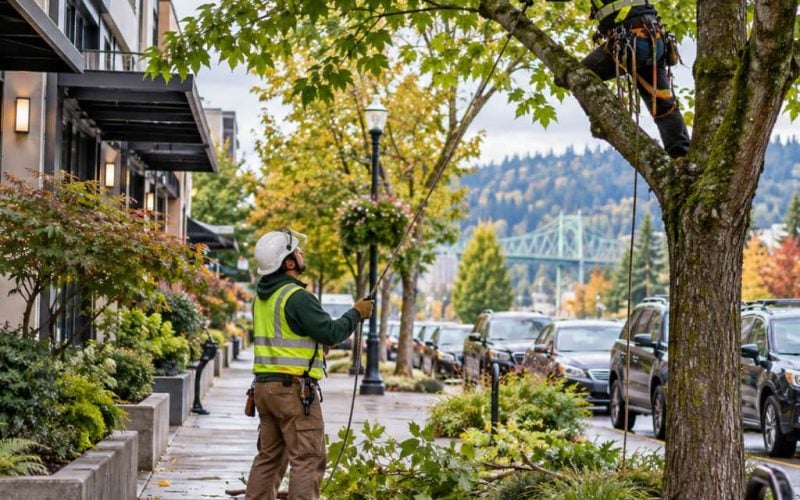
Street trees in Portland require a permit for pruning even if the tree is the responsibility of the adjacent property owner, such as a commercial business. For example, many businesses have trees in the strip between the sidewalk and the street.
People often ask do you need a permit to prune street trees in Portland. Yes. The city says a permit is required to prune any tree in the right-of-way, and all work must meet its street tree pruning standards. For most routine pruning, the permit can be self-issued online, unless the tree is a Heritage Tree.
Here’s why that matters for maintenance:
- Only the adjacent owner or their designee can apply for the permit.
- Low branches over sidewalks can trigger a city notice to prune.
- Topping or heavy cuts can count as harm to a street tree.
A maintenance partner who handles permits keeps you out of trouble, while one who doesn’t can create a violation with a single visit.
What should a landscape maintenance contract plan for across Portland seasons?
A good landscape maintenance contract plans different work for each season, because Portland’s wet winters and dry summers need very different care. Here’s how the year usually breaks down:
Season | Main tasks on commercial sites |
Winter | Storm debris cleanup, drainage checks, dormant pruning |
Spring | Mowing restarts, bed cleanup, mulch, irrigation startup |
Summer | Weekly mowing, irrigation checks, weed control |
Fall | Leaf removal, stormwater inlet clearing, irrigation shutdown |
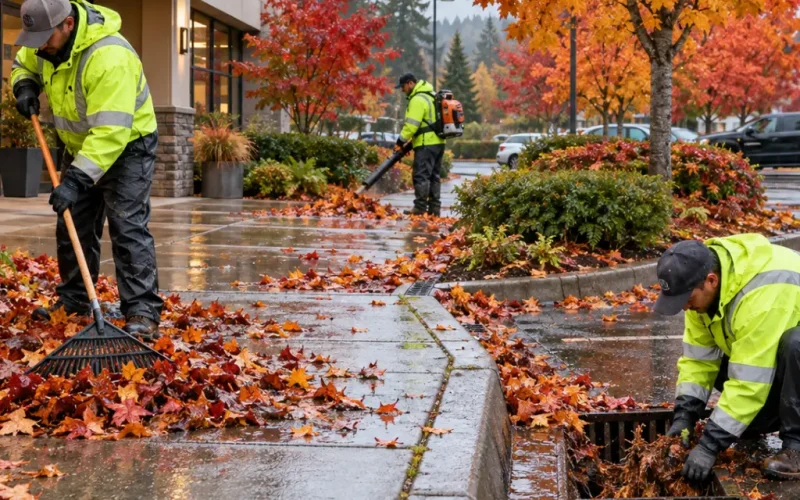
Overall, fall is the busiest time of year for commercial sites. In fact, leaves fall from the trees and clog the walks, drains and even the stormwater facilities, sometimes within a week’s time.
Summers in Western Oregon, on the other hand, are dry, so irrigation failures can kill plantings quickly. For that reason, regular maintenance matters more than most owners expect.
How can property managers check that maintenance is being done right?
Property managers can check maintenance quality with regular site walks, visit reports and a few simple warning signs. After all, you shouldn’t have to guess whether the crew showed up or did the full scope.
Here’s what to look for:
- Visit reports listing what was done and anything that needs attention
- Quarterly site walks with your account manager to review problem areas
- Clean stormwater inlets after leaf season, not just tidy beds
- Healthy, edged beds without weeds creeping in between visits
- Irrigation that matches the season, not sprinklers running in the rain
Warning signs are just as useful. Mulch piled against tree trunks, shrubs sheared into tight balls and swales filled with bark all point to crews working fast instead of working right. If you notice these, raise them early, because poor habits tend to repeat on every visit.
Finally, good communication matters too. One named contact who knows your site will catch small problems before tenants or city inspectors do.
Why choose Grover’s for landscape maintenance?
We’re a family-owned company that’s maintained properties across the Portland metro since 1995, with crews that know local plants, soils and city rules. So if you’re searching for commercial landscape maintenance Portland OR property managers rely on, you’ll get one accountable team.
People often ask who maintains business property grounds near Tigard and Tualatin Oregon. We do, along with Portland, Lake Oswego, Beaverton and the rest of the metro. And if you’re comparing landscape maintenance contractors Portland metro OR businesses trust, here’s what you get:
- Oregon CCB #100592, with general liability and workers’ compensation
- Stormwater facility care planned around your O&M requirements
- Irrigation, pruning and seasonal cleanup under one contract
- Clear reporting, so you know what was done on each visit
Wondering what does landscape maintenance cost per month? We cover pricing in our guide to landscape maintenance in the Portland metro. For contract terms, read what a commercial landscape contract should include.
You can also see our maintenance services and our work in Portland and Tualatin.
How do you get a free maintenance quote?
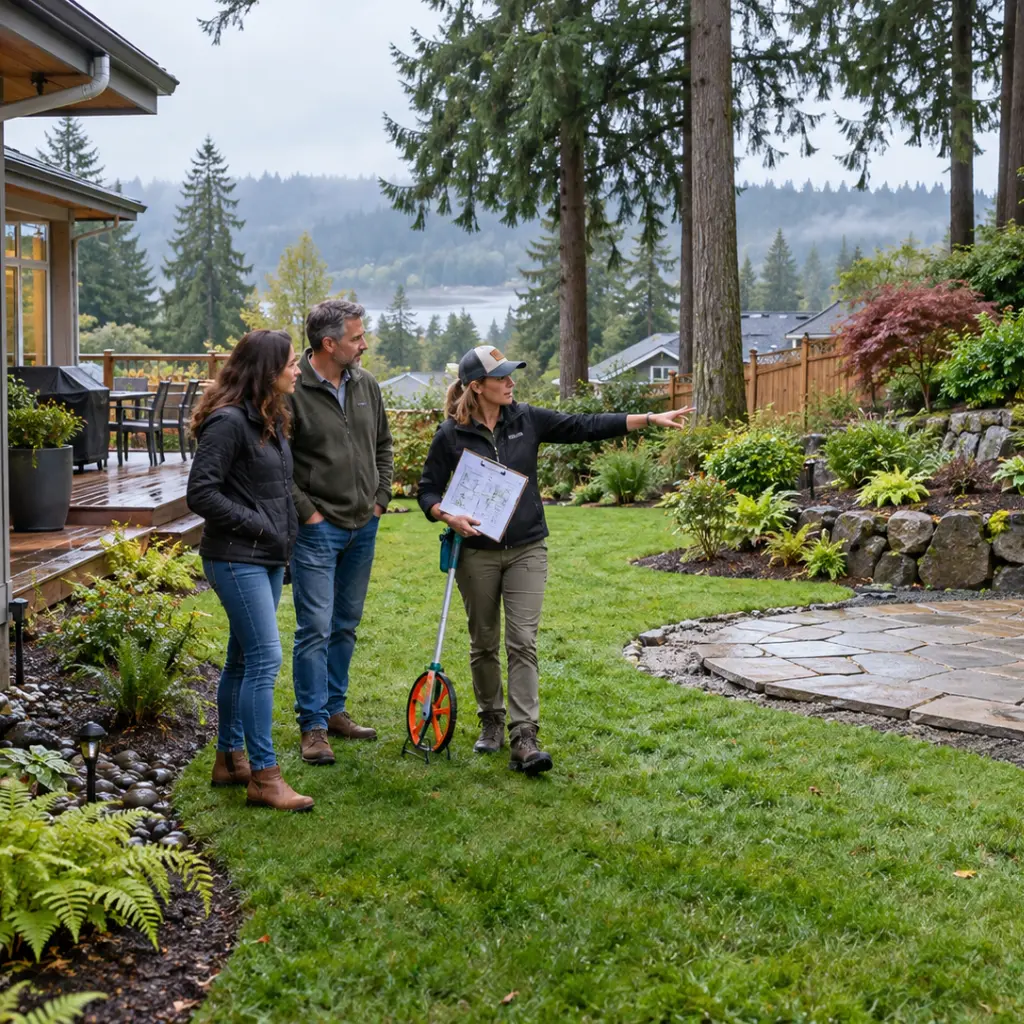
Call us or request a free quote online, and we’ll walk your property before writing a proposal. Then you’ll get a clear scope, visit schedule and price.
Frequently Asked Questions
What does a maintenance contract cover on a business property?
Most contracts cover mowing, edging, bed care, pruning, leaf removal and litter pickup. Many also include irrigation checks, seasonal color and stormwater facility care. The contract should list every task, how often it happens and what counts as extra work.
How often should a commercial property be serviced in Portland?
Most commercial sites need weekly service during the growing season, roughly spring through fall. In winter, visits often drop to every two weeks or monthly, with extra trips after storms. Busy retail or office entrances may need more frequent attention year-round.
Is a seasonal or year round contract better in Oregon?
A year-round contract is usually better for commercial sites in Oregon. Winter storms, fallen leaves and clogged drains don’t stop when mowing does. Year-round service also keeps stormwater facilities working through the wettest months.
Who clears storm debris between scheduled visits?
This depends on your maintenance contract which is why it is important to explicitly outline expectations before signing. Most contracts we offer have the option of including storm response as an à la carte service with billing done either by the hour or by visit. We will go over all included services in detail in your estimate.
How is maintenance priced on larger properties?
Larger properties are priced depending on the square footage of turf, beds and hardscape that need to be maintained, the frequency of visits and any additional services requested. Irrigation system size, seasonal color, stormwater facilities and other factors also contribute to the final price. After inspecting the property we will provide a monthly maintenance cost in writing.
Do you handle leaf removal through the fall?
Yes. Leaf removal is considered a crucial part of fall maintenance for any commercial property. Leaves that accumulate on walkways, beds, parking lots and within stormwater inlets need to be removed for the safety and continued health of the property. Additional visits may be necessary during a particularly severe leaf fall.
Can you maintain parking lot islands and planters?
Yes. Parking lot islands, planters and entry beds can all be maintained as part of a commercial property service plan. These sites are subject to additional stresses such as high traffic and salt usage during the winter. All aspects of their maintenance are included in your contract.
Do you include irrigation checks in maintenance?
Irrigation system maintenance is a part of seasonal property maintenance. We recommend turning on your system in the spring, checking for leaks or damaged heads in the summer, and winterizing the system in preparation for the colder season. This helps prevent unnecessary water waste and damage to the irrigation system.
Visit or call Grover’s Landscape Services & Design
Phone: (503) 936-8910
Email: groverslandscapevwl.design@gmail.com
Hours: Monday to Friday, 8:00 a.m. to 5:00 p.m.
Oregon CCB #100592 · Family-owned since 1995 · General liability and workers’ compensation insured
Serving Portland, Tigard, Tualatin, Lake Oswego, Beaverton, Sherwood, Wilsonville, Hillsboro, Clackamas, West Linn and Salem.