
Paver Pathway Installation in Clackamas, OR
Category Walkway Installation
Why Add a Paver Pathway in Clackamas, OR?
Paver pathway installation in Clackamas, OR requires the same careful base preparation as a patio, but the design decisions are different. A pathway is a movement corridor, not a gathering space. In Oregon’s rain-heavy climate, the material and surface texture choices matter in ways that go beyond how a pathway looks. Grover’s Landscape Services & Design has been the garden path paver installer in Portland Metro that Clackamas County homeowners rely on since 1995. We bring three decades of Pacific Northwest hardscape experience to every pathway project, under Oregon CCB License #100592.
By Yuriy Cheshev, Owner · Last updated 24th June 2026
What Is a Paver Pathway?
When clients ask what a paver pathway is, the functional answer is simple. It’s a linear hardscape surface built from individual paving units — concrete pavers, clay brick, basalt, or natural stone — set on a compacted aggregate base. Its job is to connect spaces and guide movement across a property. In short, where a patio is a destination, a pathway is how you get there.
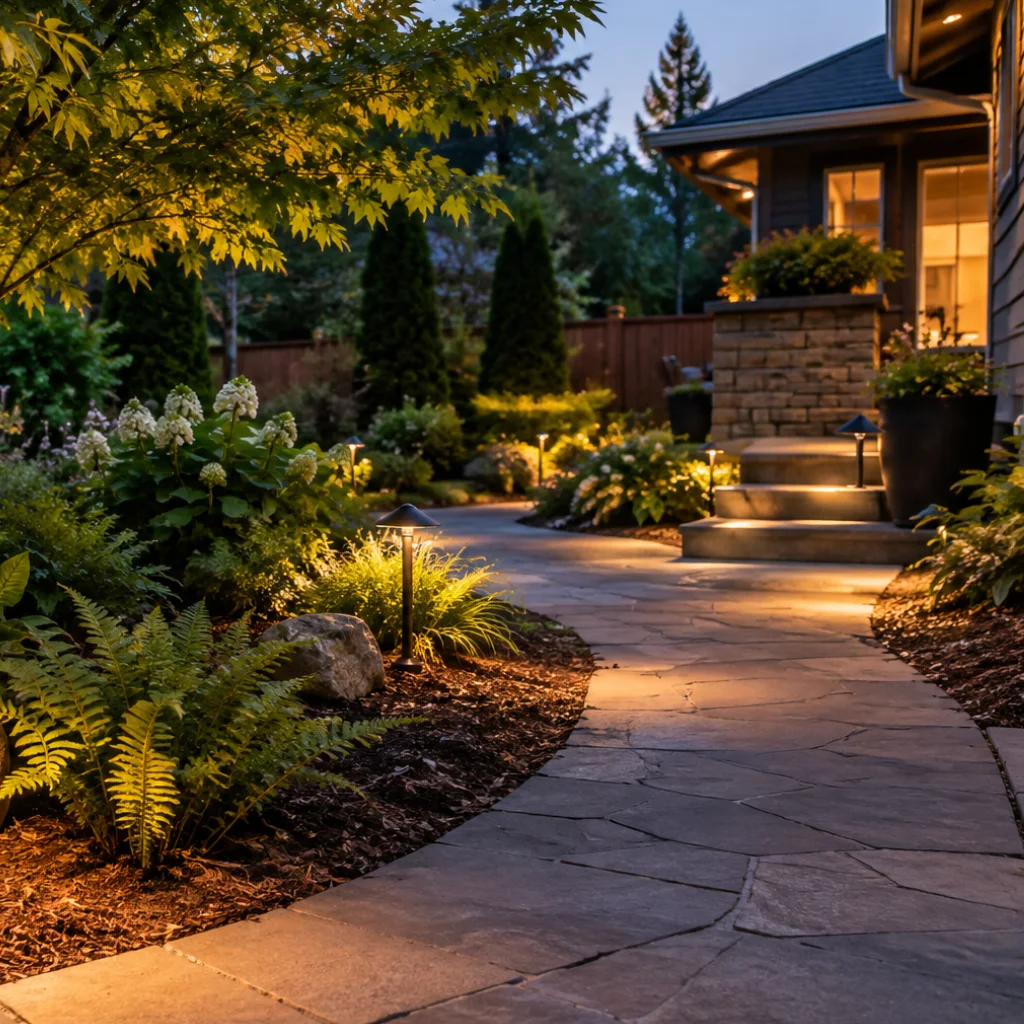
Paver pathways in Clackamas County typically serve one of three functions on a residential property. First, front-entry paths run from the street or driveway to the door. Second, utility paths connect separate structures, such as home to detached garage or home to garden shed. Third, garden paths move through planting areas and define the landscape’s circulation structure. In each case, the width requirements, paver selection logic, and grade change considerations differ.
Primary paths — front entries and main circulation routes — are typically 36 to 48 inches wide. That accommodates two people side by side, plus comfortable clearance when carrying items. In fact, setting a primary entry path narrower than 36 inches creates awkward bottlenecks.
Secondary and garden paths run 24 to 36 inches wide. That’s enough for a single person working in the garden, moving a wheelbarrow, or navigating between planting beds. In Clackamas County’s woodland and PNW garden settings, secondary paths that follow natural terrain contours integrate more naturally than straight lines do.
What’s the Difference Between a Paver Pathway and a Patio?
A paver pathway is a corridor that connects spaces; a paver patio is a defined gathering area for seating, dining, or outdoor living. They’re built with the same base materials and installation methods, but they’re designed for different purposes and sized accordingly.
The practical difference in Clackamas County comes down to drainage flow and surface texture. For example, a patio sheds water from its surface, graded away from the house at 1/8 inch per foot. A pathway, by contrast, needs to drain laterally across its width, because water shouldn’t pool on a walking surface. As a result, cross-slope drainage is part of every pathway design.
There’s another distinction too. Pathways run through planted spaces, so root intrusion is a real long-term consideration on Clackamas County’s tree-dense properties. For that reason, a path set on proper aggregate base with edge restraints and geotextile fabric resists root-driven displacement better than one set directly on compacted soil. For the patio side of this, see our paver patio installation Clackamas guide.

How Much Does a Paver Walkway Cost?
Paver walkway cost in Clackamas, OR depends on path length, width, material, and grade complexity. We price pathways per linear foot rather than per square foot, because width is standardized and length drives material and labor quantity. Here is a 2026 planning guide for the Clackamas County and Portland metro market:
Pathway Type | Cost Per Linear Foot (36″ width) |
Concrete pavers, straight path | $28 – $48 / LF |
Concrete pavers, curved path | $35 – $58 / LF |
Clay brick pavers | $35 – $60 / LF |
Natural basalt steppingstones | $32 – $55 / LF |
Tumbled concrete pavers | $30 – $52 / LF |
For a typical Clackamas County front entry path of 30 to 40 linear feet in concrete pavers, budget $840 to $2,320. A longer garden path system of 60 to 80 linear feet, curved and running through planted beds, typically runs $2,100 to $4,640.
Three factors move the number in our market. First, path complexity: curved paths cost more per foot than straight runs, because each paver requires individual cutting. Second, grade changes: integrated steps add $200 to $500 per step, depending on material and riser width. Third, base depth: Clackamas County’s clay soils require a 6-inch compacted aggregate base as standard, which adds material cost that contractors in drier markets don’t carry.
For a free site visit and written estimate, contact Grover’s Landscape or call (503) 936-8910.
What Pavers Are Best for a Pathway?
When clients ask what pavers are best for a pathway, the answer in Oregon’s climate begins with surface texture, not aesthetics. A pathway is a walking surface used in the rain, and smooth or polished pavers become slip hazards when wet. So in Clackamas County’s eight-months-of-rain climate, every paver on a walking surface should have a textured or tumbled finish.
Tumbled concrete pavers are the most popular pathway choice in the Portland metro, for a practical reason. Specifically, the tumbling process rounds edges, creates surface texture, and gives pavers a settled, slightly aged appearance that integrates naturally with the planted PNW garden. In addition, the texture provides reliable grip when wet, and multiple size formats allow natural-looking random patterns.
Clay brick pavers offer the best long-term color stability of any paver. Specifically, the color goes through the material, not just the surface, so it doesn’t fade under UV. For front entry paths where the pathway is prominent, clay brick’s permanence of color is a genuine long-term advantage. Its textured wire-cut faces also provide appropriate grip when wet.
Basalt pavers or steppingstones suit Clackamas County’s woodland and naturalistic garden settings well. For example, basalt’s gray-green tones blend with Oregon’s native plant palette — sword ferns, native sedges, shade-tolerant perennials — in a way concrete can’t replicate. Moreover, rough-sawn basalt has a natural grip that polished stone lacks.
Smooth or polished pavers — flagstone, polished concrete, or glazed brick — are not appropriate for primary pathway surfaces in Oregon’s climate. They look striking in dry conditions, but they become slip hazards in rain. Instead, reserve them for covered entries where the surface stays dry.
For design guidance on paver materials that integrate with your planting palette, our landscape design page covers hardscape and softscape coordination.

Curved Paths, Grade Changes, and Root Intrusion in Clackamas County
Three design considerations distinguish pathway projects from patio projects in practice. All three are particularly relevant in Clackamas County’s terrain and planting culture.
Curved vs. Straight Alignment
Clackamas County properties often have naturalistic garden settings where a straight path reads as incongruous. A gently curved path that follows terrain contours or moves through planting beds integrates more naturally with planted landscapes. However, curved paths require more cutting and labor than straight runs. Tighter curve radii mean more paver cuts and more material waste, which is why they cost more per linear foot.
Grade Changes and Integrated Steps
Many Clackamas properties involve grade changes along path routes. For safety and comfort, steps integrated into a paver pathway need consistent riser heights (4 to 7 inches) and tread depth (minimum 12 inches). The Clackamas County building permits office can confirm when grade changes require permits. Generally, residential garden paths don’t trigger permit requirements unless structural walls are involved.
Root Intrusion Near Mature Trees
Clackamas County’s established properties often have mature Doug firs, oaks, and large ornamentals whose roots extend into garden path areas. Geotextile fabric beneath the aggregate base significantly delays root migration into the base material. As a result, it extends stable path life by years compared to paths installed without fabric. For properties with significant tree root systems, we discuss routing during the site visit to minimize future root conflicts.
Hiring the Right Contractor for Garden Paths and Walkways
As a paver walkway contractor in Clackamas County with 30 years of Pacific Northwest hardscape experience, Grover’s Landscape evaluates every pathway project on-site before quoting. After all, base depth, drainage direction, grade changes, root proximity, and paver material all affect the approach. None of them can be assessed accurately without seeing the property.
When Clackamas County homeowners search for paver pathway installation near me, the distinction between contractors comes down to how the base is built. A 4-inch base may be adequate in Arizona. However, in Clackamas County’s clay-silt soils and 45-inch annual rainfall, 6 inches of compacted aggregate base is the minimum for a pathway that stays stable through our wet-dry seasonal cycles.
We’re the contractor for garden paths and walkways Clackamas County homeowners work with directly. In every case, we provide a site visit, written proposal, and timeline commitment before any work begins. For properties requiring both hardscape and softscape coordination, we bring landscape design and construction expertise to every pathway project. After all, the path needs to work with the planting, not just sit next to it.
Are you looking for paver walkway installation near me in Portland and the broader Clackamas County area? Grover’s serves Oregon City, Lake Oswego, Milwaukie, Happy Valley, Gladstone, and surrounding communities. Our hardscape construction page covers the full scope of our paving work. Request a free quote or call (503) 936-8910 to schedule your site visit.
Frequently Asked Questions
What's the difference between a paver pathway and a patio?
A paver pathway is a movement corridor connecting spaces — the route you walk from entry to door, or through a garden. A paver patio is a gathering area sized for seating and outdoor living. Both use the same aggregate base system. However, pathways are designed for directional movement, typically 24 to 48 inches wide, and require cross-slope drainage across their width. Patios are designed as destinations, typically 150 to 500+ square feet, and drain away from the house along their surface grade.
How much does a paver walkway cost in Clackamas, OR?
Paver walkway installation in Clackamas, OR typically runs $28 to $60 per linear foot for a 36-inch-wide concrete or clay brick path. A 30-to-40-foot front entry path in concrete pavers runs $840 to $2,320; a 60-to-80-foot curved garden path system runs $2,100 to $4,640. Curved paths, integrated steps, and Clackamas County’s required 6-inch aggregate base all increase cost over national averages.
What pavers are best for a pathway?
In Oregon’s wet climate, textured or tumbled concrete pavers, wire-cut clay brick, and rough-sawn basalt are the best pathway paver materials, because they provide grip when wet. Smooth or polished pavers become slip hazards on a walking surface in rain. Tumbled concrete pavers are the most popular choice in the Portland metro for their texture, natural appearance, and integration with PNW garden settings. Clay brick offers the best long-term color stability. Basalt suits naturalistic or woodland garden paths particularly well.
How long does paver pathway installation take?
A standard residential paver pathway of 30 to 50 linear feet typically takes 2 to 4 days on-site. That covers base excavation, aggregate base compaction, edge restraint installation, paver laying, and jointing sand application. Curved paths, grade changes requiring steps, or longer paths with complex paver cutting take longer. Grover’s provides a written timeline with every project proposal.
Do paver pathways require much maintenance?
No. Annual inspection of edge restraints and joint sand is the primary task. In Clackamas County’s climate, polymeric jointing sand that cures hard and resists washout in rain is worth the modest cost over standard sand. Individual pavers that settle can be lifted and reset without disturbing the surrounding path — a repairability advantage that poured concrete doesn’t offer.
Contact Grover’s Landscape Services & Design
Grover’s Landscape Services & Design Serving Portland and surrounding metro communities Phone: (503) 936-8910 Hours: Monday–Friday 8:00 AM–5:00 PM Oregon CCB License #100592 | Licensed & Insured | Family-owned since 1995
Providing paver pathway installation and full-service hardscape construction throughout Clackamas County, Oregon City, Lake Oswego, Milwaukie, Happy Valley, and the Portland metro.